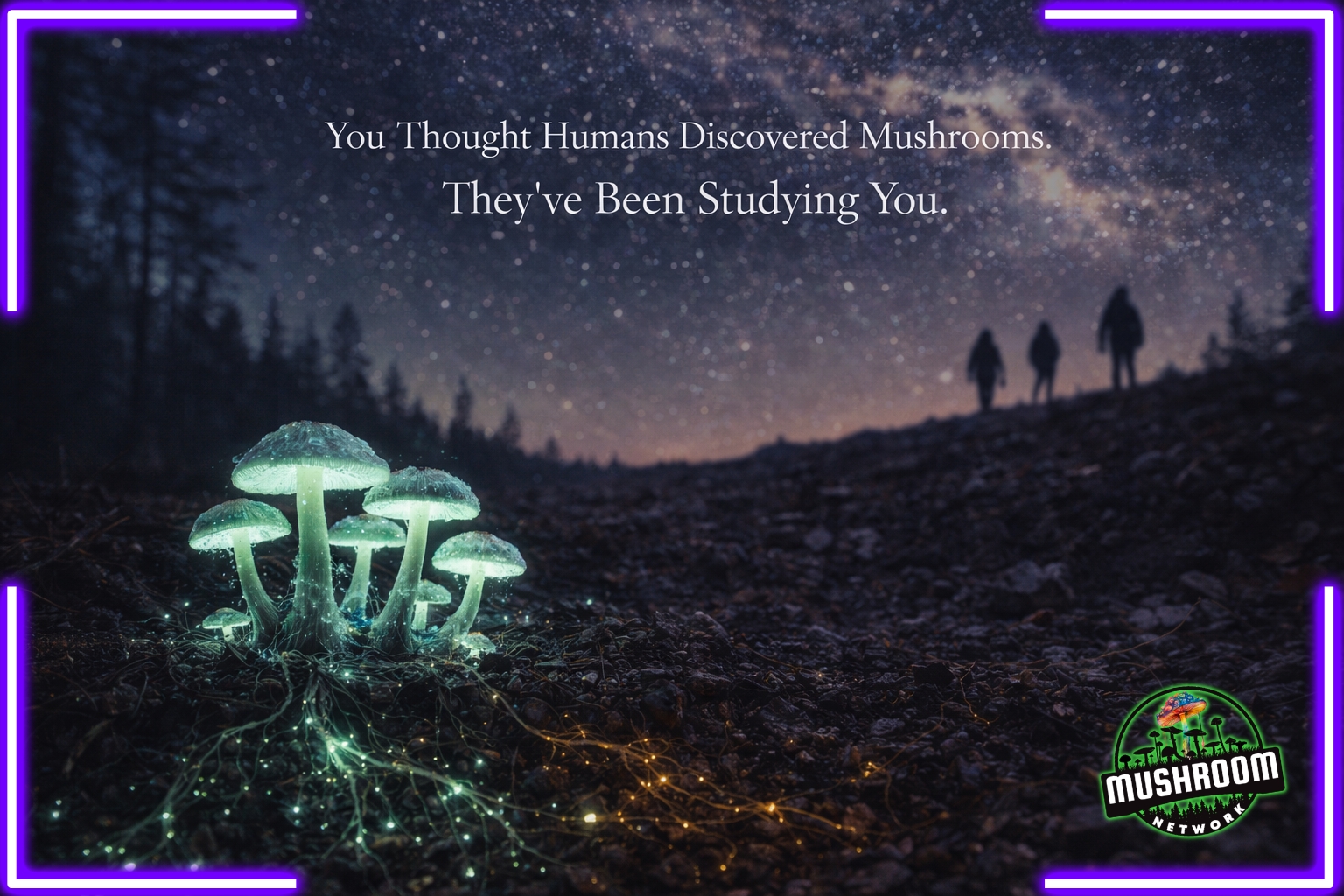




You Thought Humans Discovered Mushrooms. They’ve Been Studying You.
A field report from the organisms that predate your concepts.
Somewhere beneath your feet, a fungus has already adjusted to your presence.
Not metaphorically. Not spiritually. Mechanistically.
It has detected changes in temperature, pressure, chemistry, and resource flow caused by your species. It has altered growth patterns accordingly. It has rerouted, reinforced, deprioritized, and persisted. No eyes. No neurons. No inner monologue whispering, “Ah yes, humans.”
And yet, the response happened.
If intelligence requires a brain, this organism is operating illegally. If intelligence requires awareness, it’s cheating. And if intelligence requires a sense of self, the fungus didn’t get the memo and continues functioning anyway.
Humans like to believe we study nature from a safe distance, like scientists behind glass. Fungi have never shared that assumption. They experience us the way systems experience disturbances: as patterns, pressures, and signals that do not need names to be learned.
This Myco-Article is about the quiet, unnerving possibility that discovery has never been one-sided.
What If We Were Never the Main Character?
Human intelligence has a branding problem. For centuries, we’ve defined it in our own image: a thinking head, narrating itself, reflecting, planning, aware that it is aware. Anything lacking those features was politely demoted to “reaction” or “mechanism,” as if those words ended the conversation instead of dodging it.
Fungi never auditioned for this role.
They do not speak. They do not signal intent. They do not present a face we can empathize with or a story we can interview. What they do instead is far more unsettling. They adapt. Relentlessly. At scale. Over timeframes that make human civilization look like a weekend experiment.
This Myco-Article does not argue that mushrooms are conscious in the human sense. That question is a distraction. What matters is that fungal networks sense, process, and respond to information in ways that shape ecosystems, alter evolutionary trajectories, and quietly absorb the impact of our species without consulting our definitions.
We are going to explore fungi as perceivers without eyes, learners without memory, and intelligences without identity. And once you see what they are actually doing, the idea that humans are the primary observers of the natural world becomes very hard to defend.
Environmental Surveillance, But Organic
If you wanted to design a perfect surveillance system, you would not give it eyes.
You would give it contact.
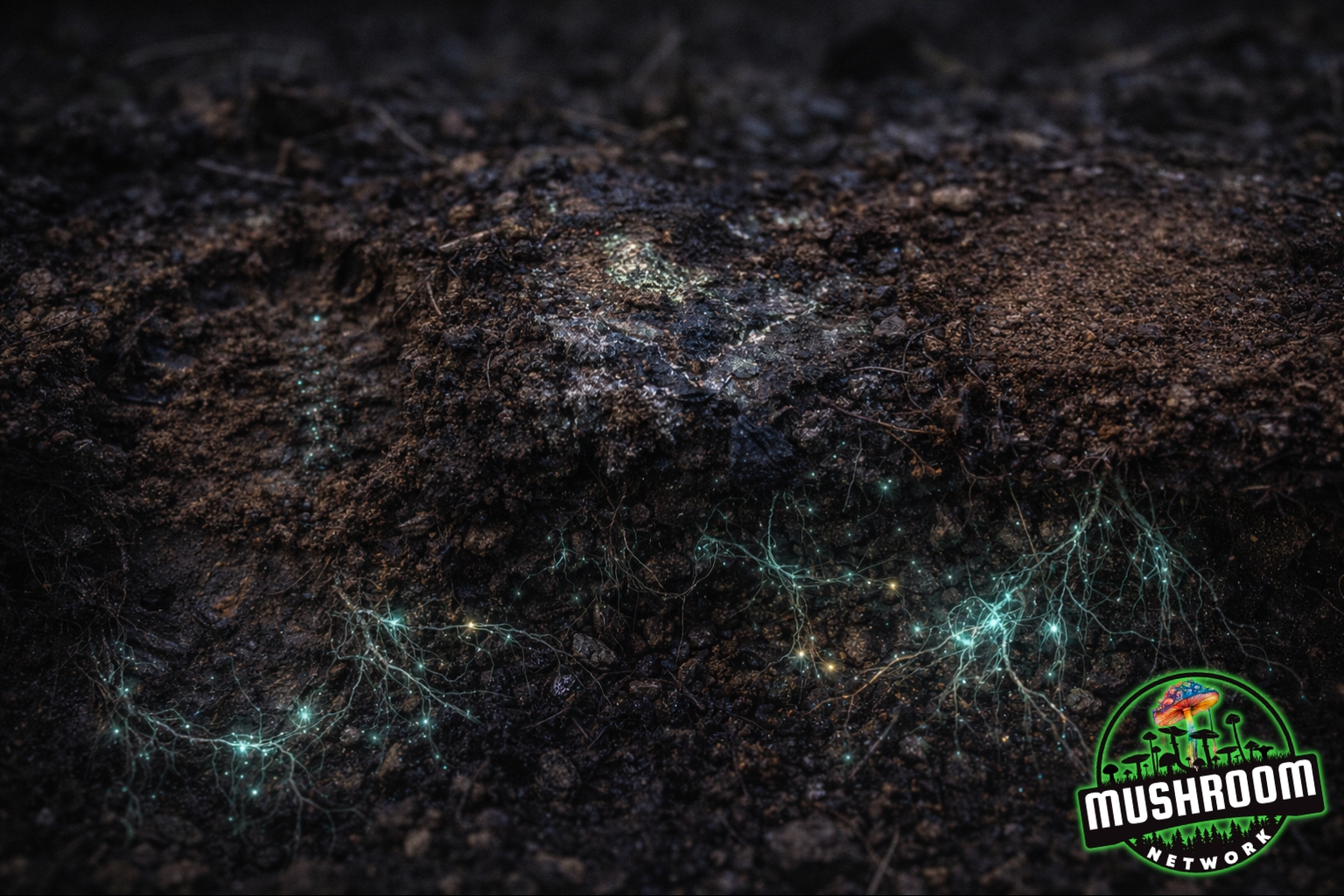
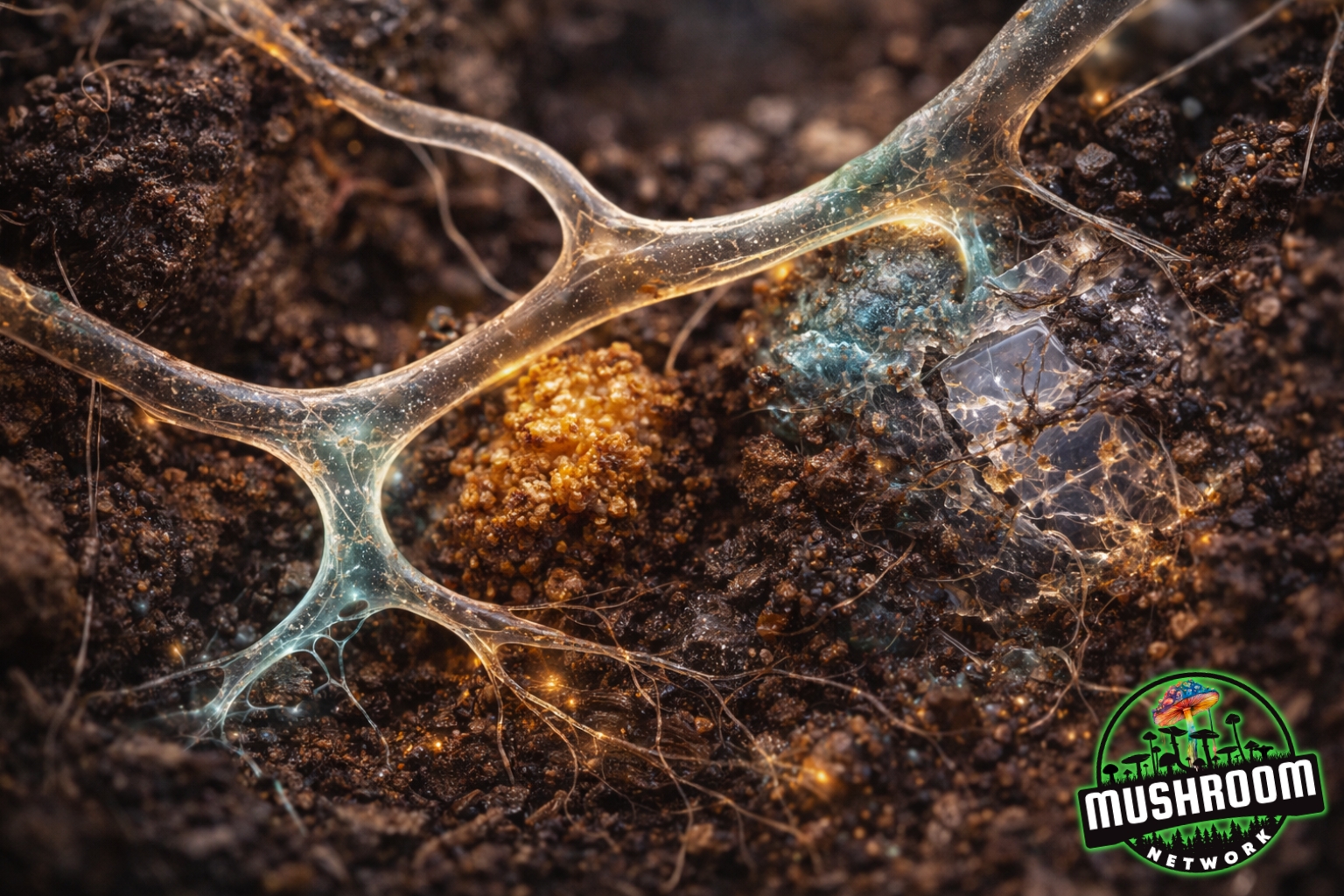
Fungi are in physical, chemical, and metabolic contact with their environment at nearly every point of their existence. Hyphae press against soil particles, roots, microbes, dead wood, pollutants, moisture gradients, and heat differentials. Information is not gathered at a distance. It is forced directly into the organism’s body.
Here is the first payoff inversion: fungi do not need to recognize you to register your presence. They only need to register change.
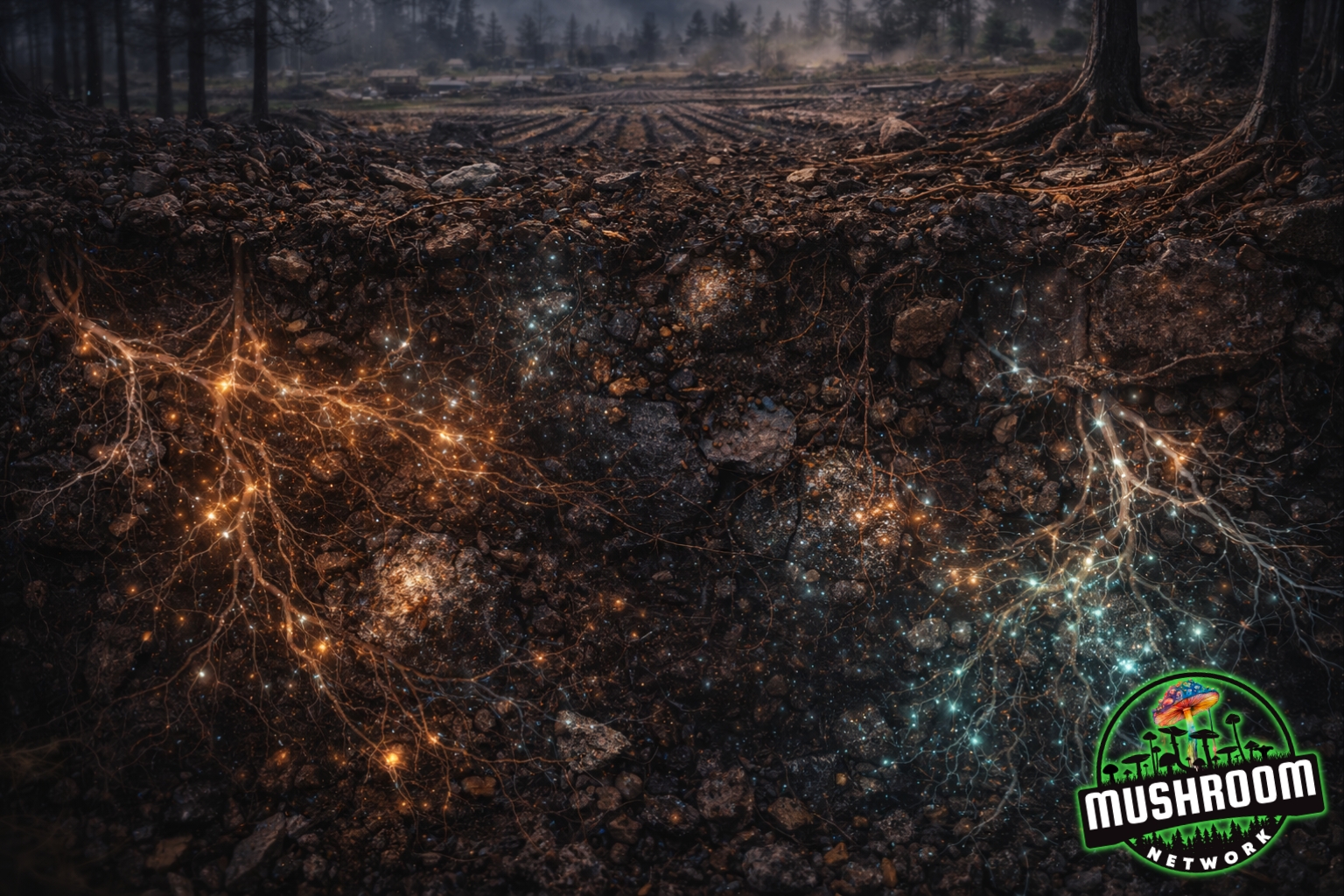
Every human action leaves a signature. Soil compaction alters pore space. Construction changes drainage. Agriculture shifts nutrient profiles. Industry adds novel chemicals. Even walking through a forest compresses soil layers in ways that persist long after footsteps fade. To fungi, these are not vague disturbances. They are precise inputs.
Mechanistically, fungal perception emerges through changes in membrane potential, enzyme expression, growth direction, and metabolic rate. A shift in pH here. A new toxin there. A reliable pulse of nitrogen in one direction. The network responds locally, but the consequences propagate globally through altered growth patterns and resource flows.
This is perception without representation. No internal model of “human.” No stored image of a bipedal ape with opinions. Just differential response tuned by millions of years of selection.
Comedic metaphor, calibrated: if humans are broadcasting reality like a badly configured radio station, fungi don’t need to know the song. They only need to notice the static pattern and adjust the antenna.
And here’s where it gets quietly uncomfortable. Fungal networks are extremely good at distinguishing persistent changes from noise. Temporary disturbances are ignored. Sustained ones are learned. Urban heat islands, agricultural monocultures, chemical runoff. These are not events. They are ongoing signals.
Which raises a simple, destabilizing thought.
If fungi are exquisitely sensitive to long-term environmental patterns, and humans are currently the loudest pattern on the planet, then adaptation is not a future concern. It is already underway.
Transition pull: Once an organism can sense you reliably, the next step is unavoidable. It adapts.
Humans as a Selective Pressure
From a fungal perspective, humans are not villains, heroes, or observers.
We are a condition.
Selective pressure is evolutionary language for “the rules changed.” Fungi have experienced countless such changes over their 1.3 billion year history. Ice ages. Mass extinctions. Shifting continents. New competitors. New partners. Humans are simply the most recent, and possibly the most aggressive, rule change the biosphere has seen.
Here’s the real-world payoff that tends to short-circuit denial: fungi are already adapting specifically to human-altered environments.
Pathogenic fungi have evolved tolerance to higher temperatures, including those approaching human body heat, a trait that was once rare and is becoming more common as the planet warms. Soil fungi have developed enzymatic pathways capable of breaking down synthetic chemicals that did not exist a century ago. Some species metabolize plastics. Others survive in radioactive environments by converting radiation into usable energy.
This is not resistance in the dramatic, us-versus-them sense. It is learning in the only language evolution speaks.
Short tangent, returning immediately: the AI Bro would like to interrupt and say, “That’s just evolution.” Correct. And earthquakes are “just plate tectonics.” Naming the mechanism does not diminish the implication. Evolution is a distributed learning process operating without foresight, consciousness, or concern for narrative satisfaction.
Fungi do not need to predict humanity’s future. They only need to survive our present. And in doing so, they encode information about us into their physiology, their tolerances, and their ecological roles.
Here’s the unsettling inversion: humanity is not studying fungi in a vacuum. We are participating in an experiment where our behaviors become data points in other organisms’ adaptive processes. Antibiotics, fungicides, land use. These are not neutral tools. They are training inputs.
And fungi, unlike us, do not argue about whether adaptation is happening. They simply update.
Cliffhanger: If fungi are adapting to us as an environmental condition, not an adversary, where does that adaptation lead?
The Cosmic Humbling of Not Being the Only Intelligence
This is the point where the discomfort stops being biological and starts being philosophical.
Humans struggle with the idea that intelligence might exist without awareness, intention, or identity. We equate “thinking” with a narrated inner life because that is how ours works. But fungi force a different framing.
They sense. They respond. They persist. They shape outcomes.
They do all of this without a self.
Here’s the callback, sharpened until it cuts: you are not the observer. You are the substrate.
Fungal intelligence, if we dare use the word honestly, is not concerned with being recognized. It does not reflect on itself. It does not ask what it means. It does not pause to wonder if it is intelligent enough to count. And that may be precisely why it scales so well.
Cosmic zoom-out, C7 bleed engaged.
If intelligence is the capacity of a system to respond adaptively to information, then the universe may be far more crowded than we like to admit. Minds without mirrors. Intelligences without stories. Systems that learn without caring whether learning is acknowledged.
Perhaps consciousness is rare not because intelligence is rare, but because self-centered intelligence is inefficient at planetary and cosmic scales. The universe favors processes that work quietly, redundantly, and without insisting on being the main character.
And suddenly, mushrooms stop being a curiosity and start being a warning. Not of doom. Of humility.
If fungi can process information, adapt to novelty, and outlast catastrophes without ever knowing they are doing so, then intelligence is not a crown to be worn. It is a behavior to be recognized.
Set-up to conclusion: If fungi have been “studying” us simply by surviving us, what does that say about discovery, dominance, and the stories we tell ourselves?
🌟 MycoTip the Network! 🌟
themushroomnetwork@vipsats.app

🌀 Myco-Conclusion: The Experiment Was Never One-Sided
Humans love discovery because it keeps us centered. It frames the world as something waiting patiently for our attention. But fungi have never waited. They have only responded.
They sensed our arrival. They registered our impact. They adjusted. No judgment. No confrontation. Just adaptation.
So here is the final cosmic question, Myco-Patrons, delivered without ceremony: if intelligence does not announce itself, does not narrate itself, and does not care whether it is recognized, how much of it have we already overlooked while congratulating ourselves on being alone at the top?
Final mic-drop, placed gently into the soil where it belongs: you didn’t discover mushrooms.
You merely became noticeable.
Suggested Myco-Articles For You:
The Wood Wide Web: How Trees Text Each Other with Mushrooms
Somewhere below your toes, a network older than human speech pulses with life. Trees aren’t standing still—they’re texting each other using mushrooms as messengers. Welcome to the Wood Wide Web: an underground internet powered by mycelium, where forests share food, warnings, even emotional support. This isn’t fantasy. It’s fungal science...
Read More...Journey Prep: A Psylo-Pioneer’s Guide to Your First Shroom Experience
So, you want to meet the mushroom? This Psylo-Pioneer’s Guide arms you with the wisdom (and weirdness) for your very first shroom experience. From cosmic safety tips to spiritual navigation, discover how to prep, set the scene, and avoid those “oops, the wallpaper’s judging me
Read More...Transmission Update – Ad-Free, Vibrant, Expanding
🍄🌀 TMN-News & Updates Latest transmissions, cosmic breakthroughs, and network updates from the Myco-Verse. 🔮 Transmission Update: The Network Has Shifted [02/07/2026] Testing complete. Signal stable. If the Network feels different lately… that’s because it is. The Grand Cosmic Mycelial Network has undergone a major internal evolution. The noisy, stale,...
Read More...❄️ The Cold-Born Shroom: How Enoki’s Genetics Thrive in Freezing Darkness
Buckle up, Myco-Wanderer. We’re diving into the frost-coded fungal genetics of Enoki—yes, that long, noodle-like mushroom in your ramen. But don’t let its skinny frame fool you. Beneath that ghost-white stem is a mutant power born from cold darkness, lab manipulation, and cell-apoptosis wizardry. Learn how Enoki’s genes adapted to...
Read More...Myco-Article v1.0.4 [Bravo]
How sporetacular was this post?
Tap a star to send your spores of approval (or helpful feedback!)
Oh no! The spores missed their mark…
Let’s co-create a sporetacular post together!
Share your wisdom—how can we make this more Cosmic?