

Symbiotic Systems: Why Life Chooses Cooperation
The science of why fighting is expensive and fungi are efficient
Nature documentaries lied to you. Not maliciously. Just… dramatically. Because if you actually look closely at how life works, it’s less claws-and-chaos and more spreadsheets-and-cooperation, with fungi quietly doing logistics in the background. This is the story of the underground networks that make forests function, bodies survive, and ecosystems outlive extinctions. Read this if you enjoy having your assumptions gently dismantled and replaced with something smarter.
Let’s Ruin “Survival of the Fittest” Real Quick
If you shrink yourself down to the size of a soil mite and tumble headfirst into a handful of forest dirt, you might expect chaos. Teeth. Claws. Tiny beetles throwing elbows over crumbs like it’s the last slice of pizza in the universe. That’s what we’ve been trained to expect, because “nature” has been marketed to us as an endless deathmatch narrated by someone with a very serious British accent. But once the dramatic lighting shuts off and the slow-motion violence stops, something far stranger appears. The forest floor isn’t a battlefield. It’s a network. Nutrients are traded. Signals are passed. Organisms cooperate like seasoned professionals who figured out long ago that fighting is inefficient. And at the center of it all is a quiet, branching intelligence that never asked for credit and somehow runs the entire planet.
The Underground Economy Nobody Talks About
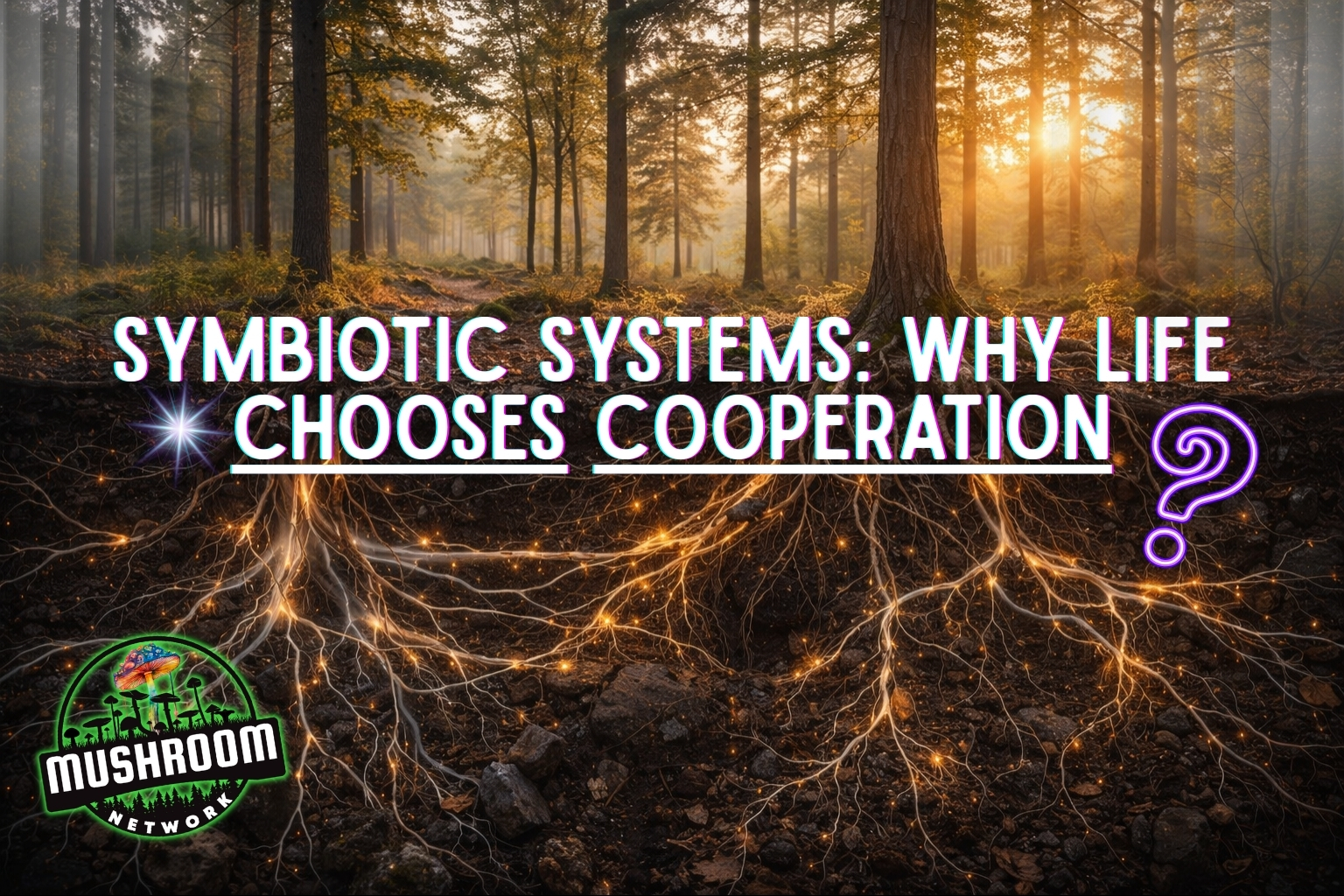
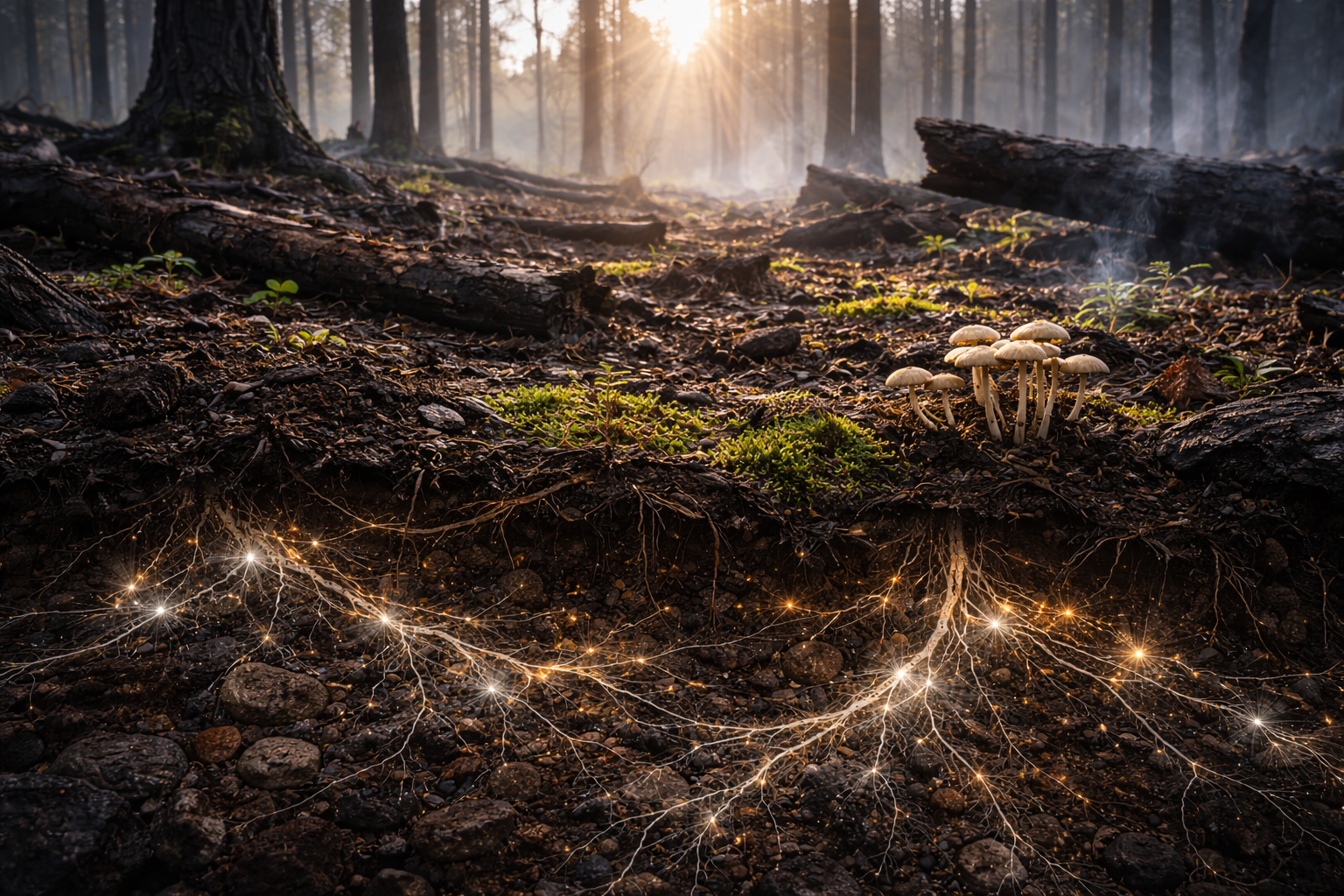
Under the forest floor lives mycelium, the main body of fungi, and calling it “underground” is like calling the internet “a few wires in the wall.” Technically true. Spiritually criminal. Mycelium is a vast, branching network of microscopic threads called hyphae that lace through soil, roots, rocks, dead leaves, insect carcasses, and whatever else happens to be lying around, forming a living infrastructure so dense that a single teaspoon of healthy soil can contain kilometers of fungal wiring. Not metaphorical wiring. Actual, nutrient-moving, signal-transmitting, decision-making biological infrastructure. Mushrooms, the part humans point at and go “oh neat,” are just the fruiting bodies. The pop-up shops. The seasonal billboards. The real organism is the quiet, sprawling backend that never clocks out and never asks for credit.
And this network is not just sitting there vibing. It is actively moving carbon, nitrogen, phosphorus, water, and micronutrients across the landscape like a planetary logistics system run by something that solved efficiency problems before animals even invented legs. Fungal networks connect the roots of different plant species, different ages, different health conditions, meaning forests don’t just grow next to each other, they talk. A young sapling stuck in the shade can receive sugars from a mature tree through shared mycorrhizal connections. A drought-stressed plant can get water rerouted from elsewhere. A plant under attack can leak chemical distress signals into the fungal network, triggering defensive responses in neighbors before the threat physically arrives, which is frankly rude levels of preparedness.
So no, the forest is not a collection of individual competitors locked in silent warfare over sunlight. It’s a distributed superorganism, a living system where survival depends less on domination and more on staying plugged in. Trees aren’t lone warriors. They’re network nodes. And once you see that, the classic “nature is ruthless” story starts to feel less like biology and more like projection.
Evolution Is an Accountant, Not a Gladiator
“Survival of the fittest” gets thrown around like it means “big muscles win,” but in evolutionary biology, fitness has never meant being the toughest guy in the room. Fitness means fit. As in, how well you integrate into your environment, how efficiently you use energy, and how reliably you reproduce without blowing up the system you depend on. Strength helps sometimes. Speed helps sometimes. Aggression helps in very narrow windows. But across deep time, what consistently wins is efficiency, and efficiency absolutely hates unnecessary conflict.
Conflict is expensive. Fighting burns energy, damages tissue, increases risk, and destabilizes systems. Cooperation, by contrast, spreads cost, reduces redundancy, and lets organisms specialize instead of reinventing the wheel every generation. Biology is a ruthless accountant. It keeps what’s cheap and cuts what’s wasteful. Fungi figured this out obscenely early. Hundreds of millions of years before animals showed up with teeth and opinions, fungi were already forming partnerships with plants, extending root systems, dissolving rock into nutrients, and making hostile land survivable. Without mycorrhizal fungi, plants never leave the water. No soil. No forests. No oxygen spike. No terrestrial life. If you enjoy breathing air and not being soup, you owe a fungus a thank-you card.
And this isn’t some niche fungal quirk. This logic repeats everywhere. Ants farm fungi like tiny agricultural professionals. Lichens are full-on biological mergers between algae and fungi, fused so completely they function as a single organism. Inside your own body, trillions of bacteria digest food, synthesize vitamins, train your immune system, and mess with your mood like they pay rent. Even the mitochondria inside your cells were once free-living bacteria that moved in billions of years ago and became the power grid of your biology. You are not an individual. You are a highly opinionated walking coalition pretending to be one thing.
This Is Bigger Than Mushrooms (Unfortunately)
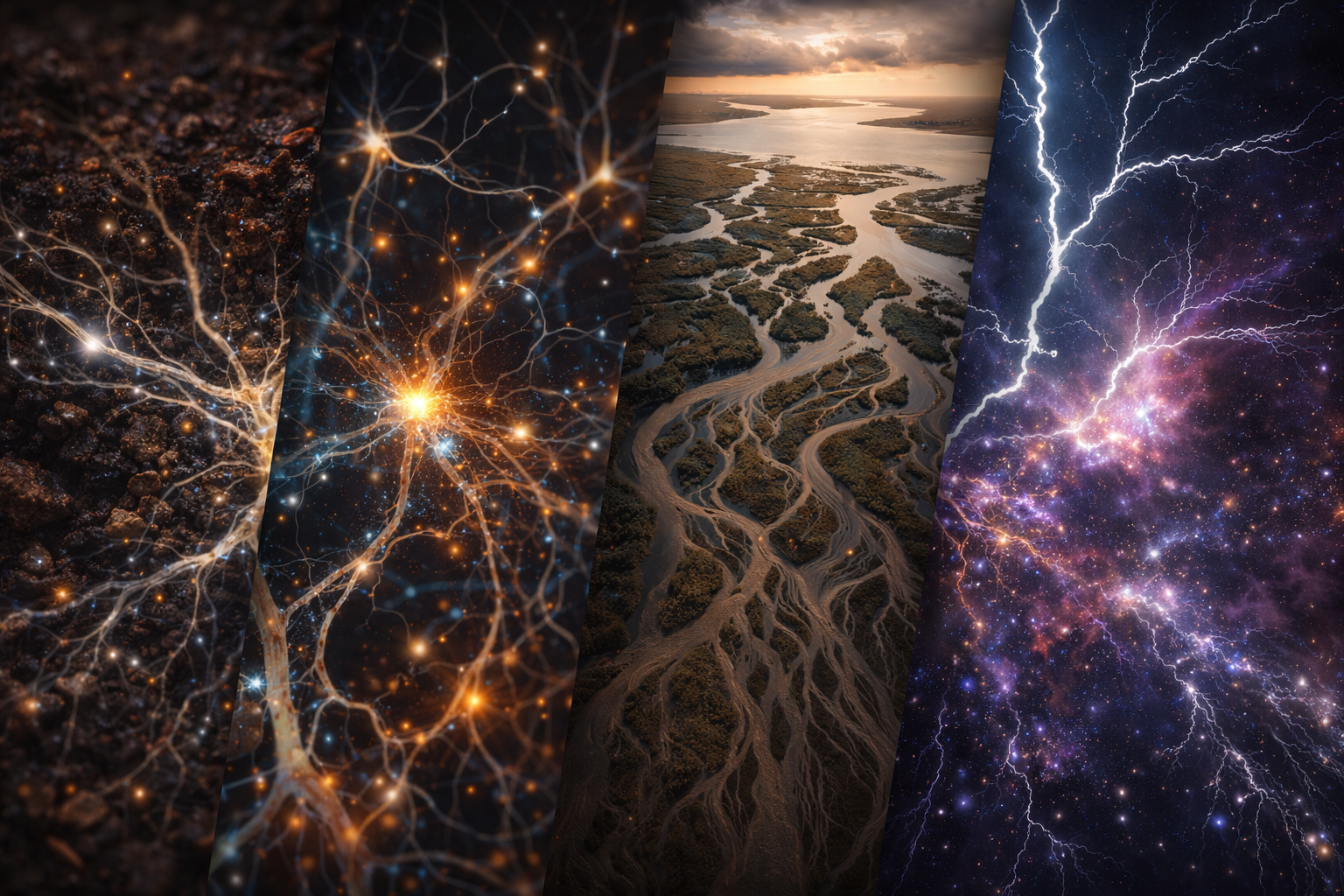
Once you notice cooperative networks in biology, your brain starts doing that thing where it won’t stop seeing them everywhere. Neurons form branching communication webs. Blood vessels distribute resources using the same efficiency patterns as fungal networks. Rivers carve dendritic systems through landscapes. Lightning fractures the sky along familiar branching paths. Even galaxies arrange themselves into filaments and voids that look suspiciously like cosmic-scale mycelium, which is either deeply meaningful or the universe reusing a really good design because it works.
This isn’t mysticism sneaking in through the side door. It’s physics and optimization. Networks distribute stress. They reroute around damage. They adapt without needing a boss. Hierarchies look impressive until something breaks, and then they fail catastrophically. Webs persist. Fungal networks survive fires, floods, freezes, and mass extinctions not by standing their ground but by reconnecting, recolonizing, and redistributing resources until balance returns. They don’t panic. They reroute.
And here’s the part humans don’t love hearing: our systems follow the same rules. Cities are networks. Roads are nutrient pathways. Power grids, supply chains, and communication systems all depend on flow. The internet is digital mycelium, routing information toward demand and away from blockages. When we interrupt flow, systems destabilize. When we support connection, resilience emerges. The future doesn’t belong to lone heroes or fragile towers. It belongs to systems that know how to cooperate, adapt, and reroute without collapsing into chaos.
🌟 MycoTip the Network! 🌟
themushroomnetwork@vipsats.app
🌀 Myco-Conclusion: Life Doesn’t Win. It Links.
Life doesn’t choose cooperation because it’s kind or moral or spiritually enlightened. It chooses it because it works. Shared systems last longer. Connected organisms adapt faster. Evolution keeps what survives, and what survives are networks that know how to move energy instead of hoarding it.
Somewhere beneath your feet right now, millions of microscopic fungal threads are making the same deal they’ve been making for hundreds of millions of years: you help me, I help you, and we both persist. The real question isn’t whether cooperation matters. It’s whether humans are ready to stop pretending they’re separate from the systems that built them. If the forest figured this out without brains, what’s our excuse?
Suggested Myco-Articles For You:
🕵️ CSI: Spore Scene Investigation
Every mushroom carries a microscopic entourage—spores, dust, and debris from the environment it calls home. Now, scientists are learning to read these invisible signatures like barcodes, linking a mushroom (or anything it’s touched) back to its exact origin. From busting truffle fraud to proving crop theft in court, forensic mycology...
Read More...🌿 Fungi: The Unsung Heroes of Forest Restoration
Forget capes and spandex—the real superheroes of forest restoration wear hyphae. In Scotland, scientists are mapping the underground fungal web that keeps trees alive and entire ecosystems humming. With less than 1% of Britain’s ancient hazelwoods left, the Society for the Protection of Underground Networks (SPUN) is on a spore-fueled...
Read More...🍄 Philly Embraces Functional Mushrooms
Philadelphia isn’t just slinging cheesesteaks anymore—it’s slinging spores. With mushroom food and beverage sales up 450% since 2021, functional fungi are taking over the city’s plates, drinks, and snacks. From Kennett Square’s global dominance to Philly’s own Mycopolitan basement farm, the mushroom revolution is both urban and cosmic. And this...
Read More...🧬 Genetic Hijacker: How Cordyceps Rewrites Insect DNA—And What That Could Mean for Us
You’ve seen the zombie ant memes. Now meet the real Cordyceps militaris—the fungus that doesn’t just possess its prey but reprograms their genetic destiny
Read More...Myco-Article v1.0.4 [Bravo]
How sporetacular was this post?
Tap a star to send your spores of approval (or helpful feedback!)
Oh no! The spores missed their mark…
Let’s co-create a sporetacular post together!
Share your wisdom—how can we make this more Cosmic?