Category Articles

🌈 Myco-Articles: The Infinite Archive

Welcome to the living, glowing library of The Mushroom Network—a spore-charged archive where wisdom, humor, and cosmic discovery collide. Every Myco-Article is a portal to a different universe: from lore and fieldcraft, to memes, wellness, science, and spiritual frontiers.
Which path will you choose?

Philosophy & Lore
Cultivation & DIY
Impact & Biotech
Food & Alchemy
Foraging & Fieldcraft
Art & Visuals
Humor & Memes
News & Breakthroughs
Guides & Resources
Health & Wellness
Community & Voices
Science & Discovery
Psychedelics & Mind
Spirituality & Mystical

🕵️ CSI: Spore Scene Investigation

Every mushroom carries a microscopic entourage—spores, dust, and debris from the environment it calls home. Now, scientists are learning to read these invisible signatures like barcodes, linking a mushroom (or anything it’s touched) back to its exact origin. From busting truffle fraud to proving crop theft in court, forensic mycology is moving from niche lab work to a trusted investigative tool. And in the Grand Cosmic Mycelial Network, spores don’t just grow—they remember.
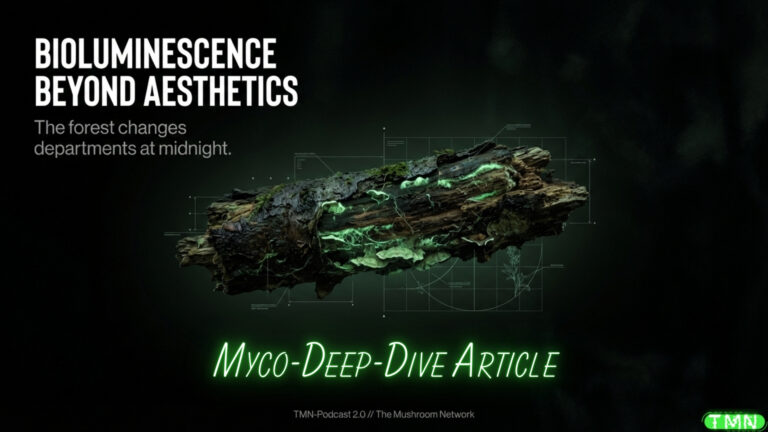
Bioluminescence Beyond Aesthetics: The Hidden Purpose of Fungal Light

At night, parts of the forest don’t go dark — they glow. Bioluminescent fungi emit cold green light through a highly efficient chemical reaction that may function as both metabolic detox and ecological signaling. What looks like woodland ambiance might actually be evolutionary strategy. And once you realize nature doesn’t waste energy on aesthetics, the glow stops being magical and starts being deeply suspicious.

🌿 Fungi: The Unsung Heroes of Forest Restoration

Forget capes and spandex—the real superheroes of forest restoration wear hyphae. In Scotland, scientists are mapping the underground fungal web that keeps trees alive and entire ecosystems humming. With less than 1% of Britain’s ancient hazelwoods left, the Society for the Protection of Underground Networks (SPUN) is on a spore-fueled mission to restore life through the ultimate symbiotic alliance: tree + fungus. Turns out the future of forests depends on the tiniest architects in the dirt.

Silent Assassin: Rare Fungus Strikes in Sub-Saharan Africa

A rare fungal killer—Syncephalastrum oblongispora—has just claimed its first documented life in Sub-Saharan Africa. The victim: an HIV-positive patient whose weakened immune defenses were no match for this aggressive mucormycete. This isn’t just a tragic case—it’s a cosmic alarm bell that fungi don’t play favorites. They adapt. They invade. They kill. Myco-Patrons, the spores are reminding us: vigilance is survival.

The Shiitake Code: Unlocking Nature’s Immune Source Code

What if your immune system had a fungal co-pilot? 🍄 The shiitake mushroom, beloved in stir-fry, might also be whispering genetic upgrades through a compound called lentinan—tweaking T-cells and flipping anti-tumor gene switches like a cellular DJ. In this deeply sporetacular Myco-Article, we crack open the Shiitake Code and explore its role as an immune symphony conductor, ancient breeder’s masterpiece, and tree-whispering forest hacker. Tap in, Myco-Wanderers—your genome may already be listening.

🌍 Underground Rainforest Networks: Fungi as Climate Heroes

Hidden beneath our feet are the fungal freeways that could rewrite Earth’s climate story. In Scotland’s Ballachuan Hazelwood, scientists from SPUN are sequencing fungal DNA to reveal the networks that let seedlings thrive and forests recover. This work stretches across the globe—from Colombia to Palmyra Atoll—mapping the Grand Cosmic Mycelial Network as a restoration blueprint. With Britain’s moist climate still ripe for temperate rainforest revival, fungi are stepping up as climate heroes, rebuilding ecosystems one spore at a time.

⏳ The Fungal Fossil: Can Agarikon’s 50-Year Lifespan Unlock Microbial Time Travel?

What if the cure to tomorrow’s viral outbreak was written into a mushroom that’s been growing since the ’70s? Enter Agarikon (Fomitopsis officinalis)—the long-living shelf fungus once used to treat plague symptoms and now being researched for its powerful antiviral genetics. From its towering, beehive-like form to its decades-long growth on ancient conifers, Agarikon might just be the fungal equivalent of a microbial time machine. Open the vault.