Mushrooms Are Rewriting the Rules of Intelligence (And Nobody Told the AI Bros)

There is a fungus in the forest right now solving a problem you would struggle to describe, let alone fix.
The Network That Connects Us All!
🌈 Myco-Articles: The Infinite Archive
Welcome to the living, glowing library of The Mushroom Network—a spore-charged archive where wisdom, humor, and cosmic discovery collide. Every Myco-Article is a portal to a different universe: from lore and fieldcraft, to memes, wellness, science, and spiritual frontiers.
Which path will you choose?
Philosophy & Lore
Cultivation & DIY
Impact & Biotech
Food & Alchemy
Foraging & Fieldcraft
Art & Visuals
Humor & Memes
News & Breakthroughs
Guides & Resources
Health & Wellness
Community & Voices
Science & Discovery
Psychedelics & Mind
Spirituality & Mystical

There is a fungus in the forest right now solving a problem you would struggle to describe, let alone fix.

Maitake, aka Grifola frondosa, isn’t just a fluffy gourmet—it’s a forest-born algorithm tuning blood sugar through fractal-coded polysaccharides. Deep within its tree-dwelling genetics lie SX- and D-Fractions—compounds that can modulate insulin response like a biological DJ. But Maitake’s growth pattern, too, follows hidden forest codes: a genetic fractal geometry that mirrors the symbiosis of roots, sugars, and survival. What if this mushroom is showing us how nature thinks?

In the year 6092 (depending on your timeline), the Myco-Verses were rocked by the Frequency War—a battle not of weapons, but of resonant basslines and fungal signal storms. Leading the charge? Interdimensional Mushroom DJs who didn’t play music—they channeled it from the Grand Cosmic Mycelial Network itself. This is their story. This is your soundscape. And whether you know it or not, the war never really ended.

Move over, astronauts—fungi might be the real stars of space travel. In multiple out-of-this-world experiments, spores have survived freezing cold, scorching UV, and cosmic radiation without

Every mushroom carries a microscopic entourage—spores, dust, and debris from the environment it calls home. Now, scientists are learning to read these invisible signatures like barcodes, linking a mushroom (or anything it’s touched) back to its exact origin. From busting truffle fraud to proving crop theft in court, forensic mycology is moving from niche lab work to a trusted investigative tool. And in the Grand Cosmic Mycelial Network, spores don’t just grow—they remember.

Is the forest… conscious

You’ve seen the zombie ant memes. Now meet the real Cordyceps militaris—the fungus that doesn’t just possess its prey but reprograms their genetic destiny

At night, parts of the forest don’t go dark — they glow. Bioluminescent fungi emit cold green light through a highly efficient chemical reaction that may function as both metabolic detox and ecological signaling. What looks like woodland ambiance might actually be evolutionary strategy. And once you realize nature doesn’t waste energy on aesthetics, the glow stops being magical and starts being deeply suspicious.

What if your immune system had a fungal co-pilot? 🍄 The shiitake mushroom, beloved in stir-fry, might also be whispering genetic upgrades through a compound called lentinan—tweaking T-cells and flipping anti-tumor gene switches like a cellular DJ. In this deeply sporetacular Myco-Article, we crack open the Shiitake Code and explore its role as an immune symphony conductor, ancient breeder’s masterpiece, and tree-whispering forest hacker. Tap in, Myco-Wanderers—your genome may already be listening.

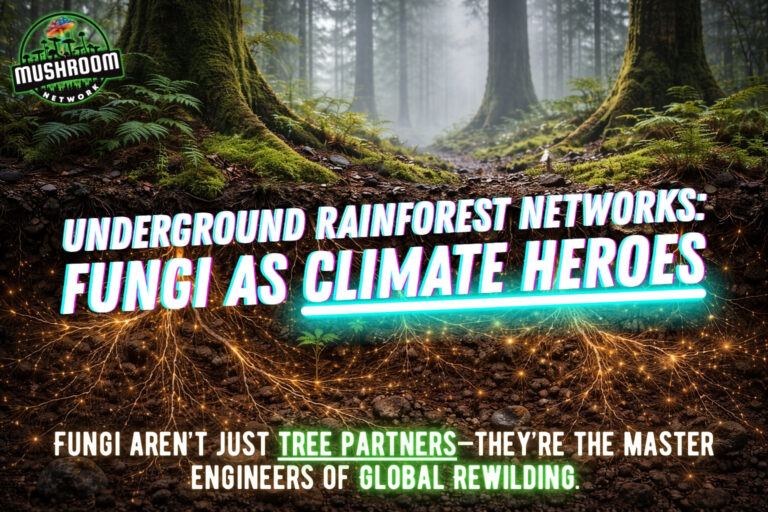
Hidden beneath our feet are the fungal freeways that could rewrite Earth’s climate story. In Scotland’s Ballachuan Hazelwood, scientists from SPUN are sequencing fungal DNA to reveal the networks that let seedlings thrive and forests recover. This work stretches across the globe—from Colombia to Palmyra Atoll—mapping the Grand Cosmic Mycelial Network as a restoration blueprint. With Britain’s moist climate still ripe for temperate rainforest revival, fungi are stepping up as climate heroes, rebuilding ecosystems one spore at a time.

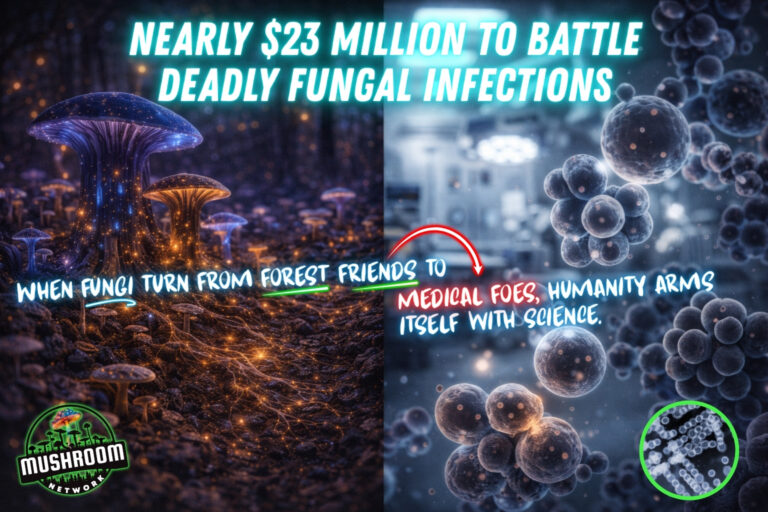
Fungi can heal, connect, and sustain—but some species kill. A new almost 23 million USD (£17.9M) initiative led by the University of Dundee, Exeter, and GSK is targeting two lethal fungal pathogens: Cryptococcus neoformans

You’re wandering the woods. A cute little mushroom smiles at you like a snack. Should you lick it? NO. This Myco-Wanderer survival article is your ultimate guide to identifying (and not