Grand Cosmic Mycelial Network Statement
The Grand Cosmic Mycelial Network is a philosophical and spiritual framework used by The Mushroom Network to explore
interconnectedness across fungi, ecosystems, consciousness, technology, and cosmic-scale systems.
It is inspired by real-world network phenomena (mycorrhizal exchange, ecological feedback loops, neural signaling, and systems theory),
expressed through symbolic language and creative storytelling.Science can map the pathways. Meaning is what travels through them.
Myco-Emporium Affiliation Notice

🍄🦋 Myco-Emporium
 is an affiliated brand of The Mushroom Network (🍄TMN).
Myco-Emporium runs its own storefront, listings, and day-to-day operations, but it remains part of the broader TMN ecosystem,
guided by the same core values: curiosity, responsible stewardship, and high-signal education wrapped in wonder.

Independent cap. Shared mycelial roots.

⚡ TMN General Disclosure:
All content provided by The Mushroom Network is for educational, informational, and entertainment purposes only. We do not provide medical, legal, or financial advice. Always consult a qualified professional regarding your unique circumstances. Views expressed do not necessarily reflect those of The Mushroom Network. Stay Sporetastic. 🍄

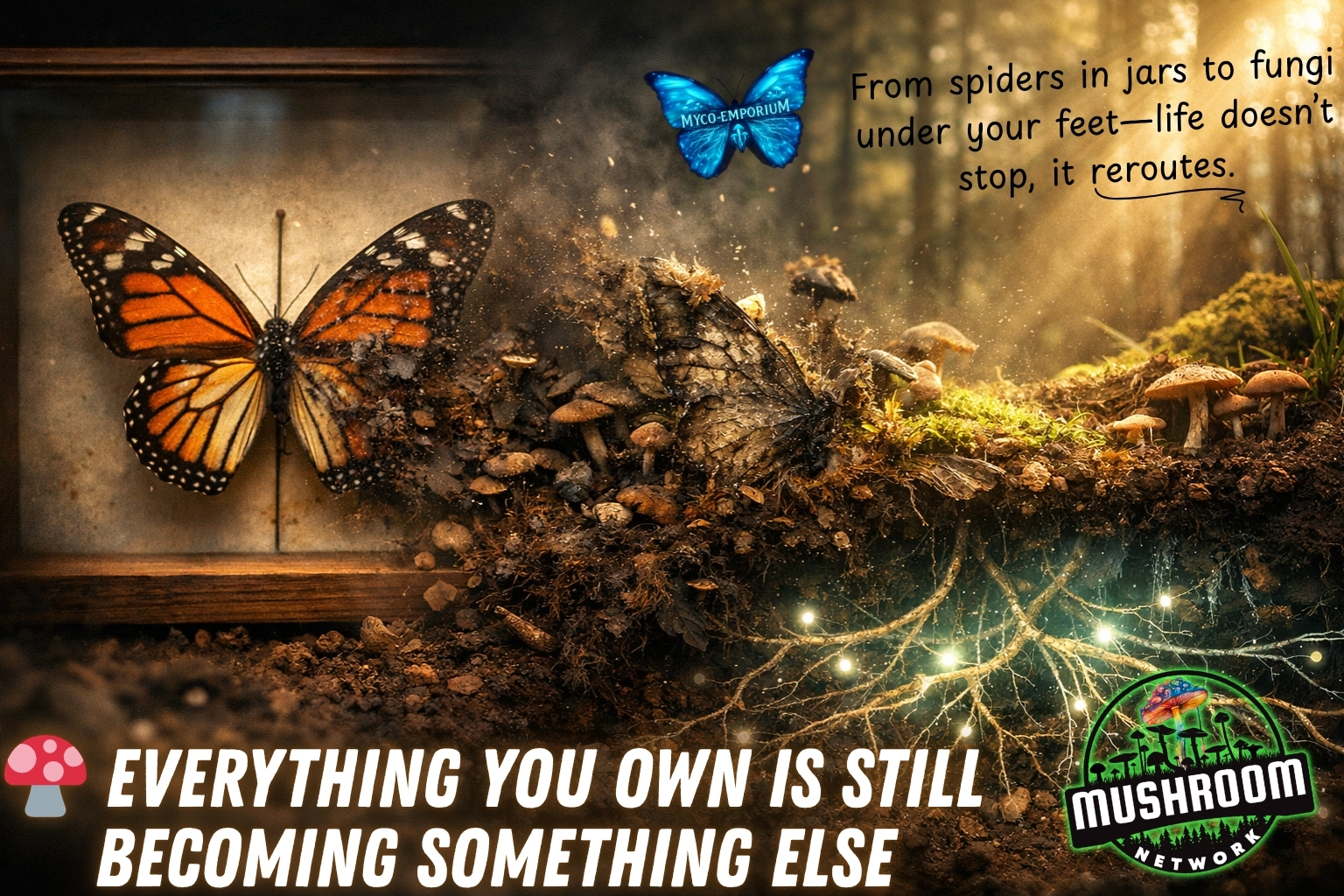
🍄 Everything You Own Is Still Becoming Something Else

Last Updated April 15, 2026
Originally published April 15, 2026

From spiders in jars to fungi under your feet—life doesn’t stop, it reroutes.

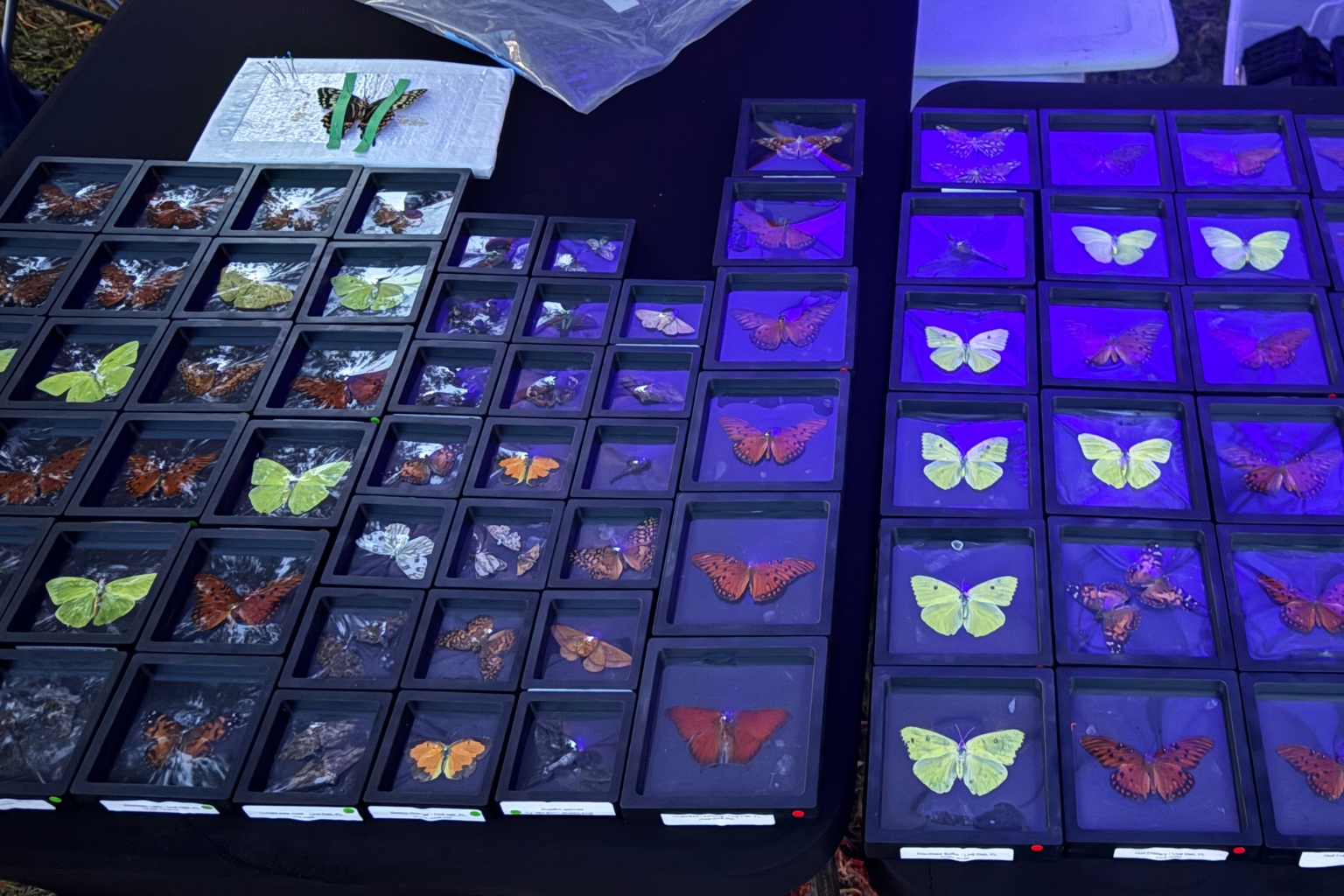
You pin a butterfly. You seal a jar. You mount a skull.
Congratulations—you’ve just paused a story, not ended it.

Because here’s the uncomfortable, slightly thrilling truth: nothing you collect is actually “dead” in the way you think. Cells collapse, sure—but molecules keep negotiating, fungi start whispering, bacteria clock in like night-shift janitors, and ecosystems begin forming tiny, invisible sequels.

And the wildest part?
Some things you think are alive… are closer to being paused than you’d like.

🌱 The Lie We Tell Ourselves About “Dead Things”

We grow up with a neat, comforting binary: alive or dead. Heart beating? Alive. Heart stopped? Dead. Case closed, biology solved, everyone go home. But reality—especially biological reality—is deeply uninterested in our neat categories.

When you collect a jumping spider, preserve a butterfly, or admire a taxidermy fox, you’re not witnessing a full stop. You’re witnessing a transition. Energy disperses. Microbes mobilize. Molecular structures persist. Entire new ecological narratives begin at scales we rarely notice.

And fungi—oh, fungi—treat “death” like a networking opportunity.

Here’s the part nobody tells you: “dead” is not a biological state. It’s a human compression of something far messier. Because matter never stops behaving—it just stops behaving in ways we recognize as life.

Zoom in, and the illusion collapses. Proteins still shift. Lipids oxidize. DNA fragments linger like half-burned letters refusing to fully disappear. Microbes arrive not as invaders, but as successors.

Micro-payoff: Even long-preserved specimens can retain usable molecular information—meaning “ended” organisms still carry readable biological history.

So what you’re holding isn’t an ending. It’s a paused configuration mid-transformation.

And once you accept that… the definition of “alive” starts to wobble.

"In the Myco-Verse, we learn that connection is a powerful force for change."

🕷️ The Illusion of Control: Living Specimens Aren’t as “Alive” as You Think

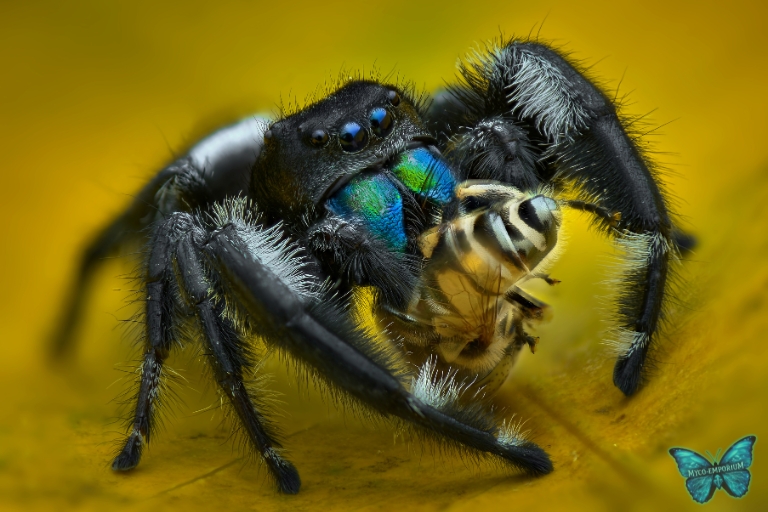
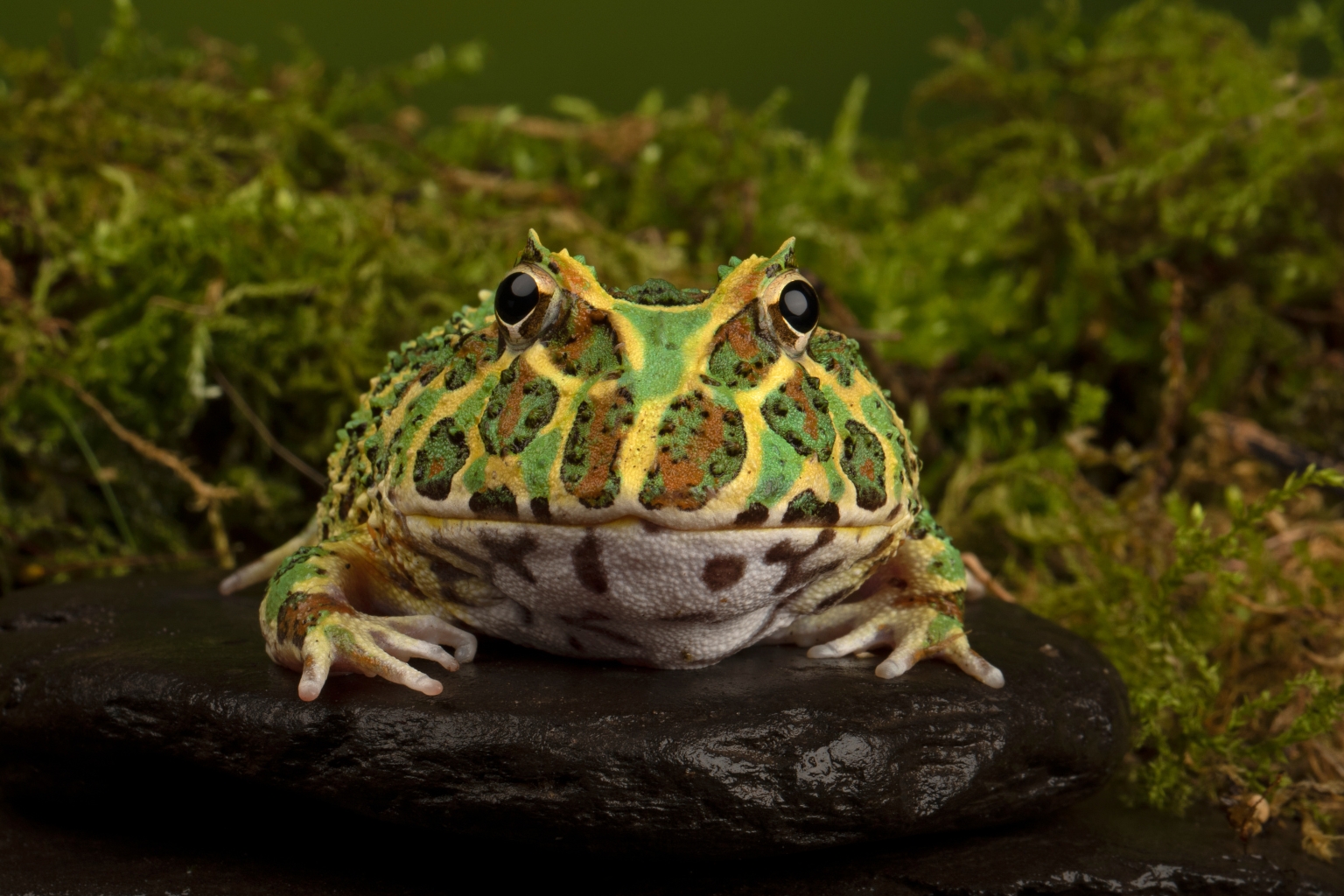
A jumping spider stares at you like it’s already read the ending of your life and decided not to spoil it. A frog breathes in slow, deliberate pulses—like a tiny green metronome keeping time for something older than you.

These are alive. Obviously. No debate. Movement, awareness, metabolism—the full checklist.

And yet…

Here’s where it gets quietly uncomfortable.

Even in these perfectly “alive” creatures, things are falling apart constantly. Cells are dying by the millions. Proteins are breaking down and being rebuilt like a construction site that never clocks out. DNA is taking damage and patching itself up like software that ships with bugs and just… keeps updating forever.

Life isn’t stable.
Life is maintenance under pressure.

Think of it like a spinning plate—classic circus act. As long as energy keeps flowing in—food, oxygen, warmth—the plate stays upright, obedient, impressive. But cut the input? It doesn’t shatter instantly. It wobbles. Slows. Starts redistributing its motion into the air, the stick, the inevitable floor.

That’s life. Not a state. Not a condition.

A performance against collapse.

Now here’s the part nobody tells you—because it sounds like something you’d whisper in a cave: some organisms don’t just perform this balancing act… they pause it.

Certain frogs can freeze. Not metaphorically. Not poetically. Literally freeze. Ice forms between their cells while special compounds keep those cells from bursting like forgotten soda cans in a freezer. Metabolism slows to nearly nothing. Heart stops. Movement stops. Everything you were taught to associate with “alive”… stops.

And then—when conditions improve—they just… resume.

Like someone hit play.

Micro-payoff: These frogs aren’t cheating death. They’re demonstrating that “death” isn’t always a clean boundary—it’s sometimes just a timing issue.

So when we say something is alive, what we really mean is:
“It is currently winning its argument with entropy.”

That’s it. That’s the whole definition, stripped of comfort.

And when that argument stops being actively maintained…

Nothing disappears. Nothing vanishes into philosophical smoke.

The system simply hands the process off.

Which means your butterfly?

Oh, your butterfly didn’t lose.

It just stopped negotiating.

🦋 Taxidermy: The World’s Most Elegant Pause Button

A butterfly pinned mid-flight looks like it made a decision and then immediately forgot what it was. Wings open, colors intact—suspended in a moment so complete it almost convinces you it’s permanent. A taxidermy animal carries that same quiet audacity, posed with just enough realism that you half-expect it to blink the second you look away.

But let’s ruin that illusion properly.

Preservation is not stopping life—it’s interrupting a sentence halfway through. What you’re seeing isn’t an ending. It’s a pause imposed on a process that was already in motion.

Because decay, despite its reputation, is not chaos. That’s the first lie. Decay is coordination—bacteria, fungi, enzymes, and moisture working together like a demolition crew that also doubles as architects. They don’t destroy things for sport; they dismantle complexity so it can be reused somewhere else. It’s less “ending” and more redistribution with intent.

When you preserve something—dry it, chemically treat it, freeze it—you don’t erase that system. You interfere with it. You slow it down, disable certain players, and stretch the timeline until it resembles stillness. But it isn’t still. It’s waiting.

And reality refuses to be subtle about this. Museum specimens over a century old still contain fragments of DNA—not whole, not functional, but readable. Like a book torn apart that still whispers its story if you’re patient enough to piece it together. Even the faint smell inside an old collection box isn’t nostalgia—it’s chemistry continuing at a pace so slow it feels like silence.

So no, it’s not dead.
It’s just quiet.

Which leads to the part most people don’t like to sit with: taxidermy is not immortality. It’s a stalemate—a very elegant, very temporary stalemate with decomposition. Given enough time, even the most carefully preserved specimens can host microscopic fungi and bacteria. Not invasions, but continuations. The process never stopped. It simply changed tempo.

So your collection isn’t a vault. It isn’t frozen in time.

It’s a slow-motion ecosystem with excellent posture.

And that raises a question that tends to linger longer than people expect:

If you didn’t end the process…
who, exactly, is continuing it?

🍄 The Network That Turns Endings Into Infrastructure

Fungi do not believe in death—not philosophically, not biologically, not even a little. To fungi, “dead” is just a word humans use when they stop paying attention.

What fungi see instead is something far more practical: availability.

The moment an organism stops actively holding itself together—stops burning energy to resist falling apart—fungi move in. Not as destroyers, and not even as invaders, but as translators. Their role is simple and relentless: take complexity and make it usable again.

Proteins, fats, carbohydrates—everything is broken down, reassembled, and redistributed through networks so vast and interconnected they make human infrastructure look improvised. Mycelium spreads underground like a biological internet, linking roots, transferring nutrients, and reallocating matter with a quiet efficiency that rarely announces itself.

And here’s the part that dismantles the illusion completely: nothing disappears.

Not your frog. Not your spider. Not your butterfly. Every atom is reassigned—into soil, into plants, into other organisms, into the air itself. What you call an ending is simply a transfer of materials into a different system.

Life doesn’t stop.
It changes departments.

If life were a company, fungi would be the liquidation team that somehow turns total collapse into expansion. Entire ecosystems rely on this process. Some fungal networks stretch for kilometers, redistributing nutrients from decomposed organisms to support entirely different forms of life. What appears to end becomes structural support for what comes next.

Which brings us back to your collection—and that idea of “paused chapters.”

Because fungi, in this story, are the editors. Not the gentle kind that fix punctuation. The kind that take your entire manuscript, break it down into raw components, and rewrite it as soil, roots, breath, and future life.

And somehow, the story doesn’t end. It continues—just in a form you didn’t expect.

So your collection isn’t a set of endings. It’s a series of interrupted transfers—moments where matter was caught mid-journey and held in place, briefly, by human intention.

But it doesn’t stay. It never stays.

Which leaves you with the only question that actually matters:

What is it becoming…
while you’re busy calling it finished?

🌟 MycoTip the Network! 🌟

Send bitcoin sats, drop spores. Every MycoTip fuels our cosmic mycelial mission!
Scan to tip Lightning
Lightning Address: themushroomnetwork@vipsats.app
Send Spores Now

🌀 Myco-Conclusion: Nothing Ends—It Just Changes Departments

If nothing is truly dead, then everything you own is not a finished object—it’s a moment in motion, temporarily held still by your perception.

Your specimens are not silent. They are simply operating in slower systems: chemical reactions, microbial succession, fungal redistribution. Processes that don’t need your attention to continue.

You didn’t end anything.
You paused it.

And that changes your role entirely.

You are not just a collector.
You are an archivist of transformation.

So here’s the question that refuses to sit still:

If every ending is just matter changing roles…
Are you preserving life—
or curating what it becomes next?

And the next time you look at that butterfly—perfect, still, suspended—

Remember:

It didn’t stop.

It just passed the story forward… to something smaller, quieter…

…and infinitely patient.

Suggested Myco-Articles For You:

Do Mushrooms Want to Heal You—or Upgrade You?

Are mushrooms cosmic doctors or alien coders? What if your microdose wasn’t a therapy session—but a software update for the soul? In this spore-spangled Myco-Article, we dive into the fungal philosophy of psilocybin as both healer and hardware hacker. Myco-Patrons, it’s time to ask: are the fun-guys fixing us… or...

Read More...
Myco-Article v1.0.4 [Bravo]

How sporetacular was this post?

Tap a star to send your spores of approval (or helpful feedback!)

Oh no! The spores missed their mark…

Let’s co-create a sporetacular post together!

Share your wisdom—how can we make this more Cosmic?

wpChatIcon