⚡ TMN General Disclosure:
All content provided by The Mushroom Network is for educational, informational, and entertainment purposes only. We do not provide medical, legal, or financial advice. Always consult a qualified professional regarding your unique circumstances. Views expressed do not necessarily reflect those of The Mushroom Network. Stay Sporetastic. 🍄

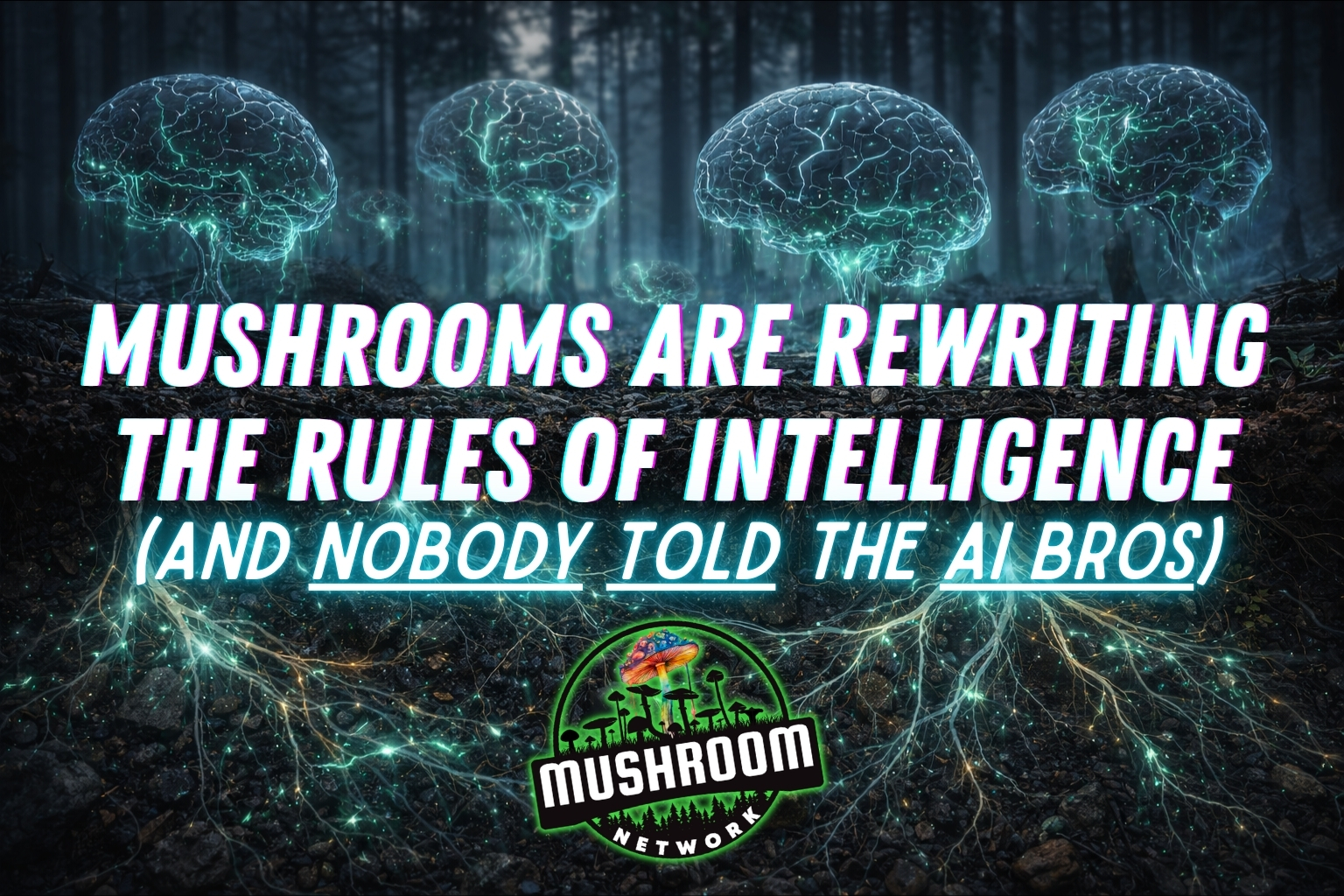
Mushrooms Are Rewriting the Rules of Intelligence (And Nobody Told the AI Bros)

If intelligence needs a brain, explain this mushroom.

There is a fungus in the forest right now solving a problem you would struggle to describe, let alone fix.

It has no brain.
No neurons.
No centralized command center issuing instructions like a tiny CEO in a skull.

And yet it is rerouting resources around damage, negotiating trades with trees, detecting environmental changes, optimizing growth paths, and responding to threats in ways that look suspiciously like decision-making. Not metaphorically. Mechanistically.

If intelligence requires a brain, this organism is committing fraud.

That’s uncomfortable, because an entire generation of humans has spent the last decade insisting that intelligence looks like a head full of thoughts, preferably speaking in complete sentences and asking to be treated ethically. Meanwhile, under your feet, a decentralized fungal network is quietly running a living optimization system that makes many of our engineered ones look fragile, expensive, and emotionally needy.

This is not a story about mushrooms being “like” the internet.

This is a story about mushrooms doing things the internet still can’t.

And once you see it, the rules we use to define intelligence don’t just bend. They snap politely and keep smiling.

What If Intelligence Is a Property of Networks, Not Heads?

For most of human history, intelligence has been treated like a VIP lounge. Entry requirements were strict. You needed a head, preferably large. You needed behavior we recognized. Tool use. Language. Self-reflection. A sense of “me.”

Anything without those features was downgraded to “mechanism,” “instinct,” or the ever-popular “just chemistry,” which is science’s version of changing the subject.

Fungi did not apply for membership. They simply went on existing, building networks that span entire forests, coordinating resource flows across species, and surviving disasters that would wipe out most centralized systems. No face. No self. No press release.

This Myco-Article is about taking fungal networks seriously as living algorithms. Not poetic metaphors. Not New Age mysticism. Literal, embodied computation happening in soil, wood, and roots. We are going to translate mycelial behavior into the language of optimization, routing, resilience, and decision-making, then follow the implications all the way out to ecology, artificial intelligence, and philosophy.

Along the way, a familiar character will appear. The AI Bro. He is not evil. He is just deeply committed to the idea that intelligence must resemble him. We will treat him gently, but we will not let him drive the bus.

By the end, the uncomfortable possibility will be on the table: intelligence may not be something you have. It may be something networks do. And if that’s true, the forest has been thinking for a very long time.

"Myco-Verse Productions reveals that fungi show us that the journey through the unknown can lead to incredible discoveries."

The Algorithm Under Your Boots: How Mycelium Optimizes Without a Brain

Walk through a forest and you are walking across a problem space.

Resources are patchy. Nutrients appear and vanish. Water pulses and retreats. Competitors steal. Grazers bite. The ground itself is hostile, irregular, and constantly changing. Any organism that survives here for long needs a way to allocate effort efficiently, detect opportunity, and avoid wasting energy on dead ends.

Animals solved this with brains.
Fungi solved it with geometry.

A mycelial network grows as a branching web of hyphae, microscopic filaments that extend, fuse, retract, thicken, and sometimes abandon entire regions of the network. At first glance, this looks like mindless growth. But zoom out and patterns emerge that are uncomfortably familiar to anyone who studies algorithms.

Here’s the first inversion, and it matters: optimization does not require global awareness. It requires feedback.

Mycelium explores widely at first, sending hyphae out in many directions. This is costly, but informative. When a hypha encounters a nutrient-rich patch, transport increases along that route. Increased flow reinforces the pathway. The hypha thickens. The connection stabilizes. Meanwhile, routes that deliver little return gradually thin out or are abandoned.

Traffic strengthens roads.
Bad investments quietly disappear.

If this sounds like reinforcement learning or adaptive routing, that’s because the same underlying logic applies. The fungus doesn’t “know” the best path. It discovers it by trying many, then letting physics and chemistry keep score.

Now it gets weird scientifically.

Experiments with fungi and slime molds have shown that these organisms can approximate solutions to network optimization problems that resemble shortest-path calculations. Not perfectly. Not symbolically. But well enough that engineers have used fungal-inspired models to design more efficient transport networks and communication systems.

The crucial point is this: the computation is happening in the body. The algorithm is not stored in a brain or a line of code. It is distributed across growth rules, material properties, and environmental feedback. The fungus computes by becoming.

This is where brains start to look a little… overengineered.

Brains are incredible, but they are also expensive, fragile, and centralized. Damage the wrong region and the system collapses. Mycelium, by contrast, assumes damage. It grows in a world where disruption is normal. When a route is cut, the network reroutes. When a region dries out, growth shifts elsewhere. There is no catastrophic failure point because there is no throne.

Cue the callback that will get sharper later: no brain, no problem.

The real punchline is not that fungi are “smart.” It’s that they reveal how narrow our definition of intelligence has been. We equated thinking with inner experience, then acted surprised when systems without inner experience still solved problems.

And we’re just getting warmed up, because optimization is the easy part.

Transition pull: If a fungus can solve routing problems without a map, what happens when it has to negotiate with other organisms who have their own agendas?

Decentralized Decision-Making: When the Network Becomes the Brain

The moment fungi partner with plants, the story stops being about efficiency and starts being about politics.

In mycorrhizal symbioses, fungi connect with plant roots and trade nutrients and water for carbon compounds produced via photosynthesis. This is not a feel-good collaboration. It is an ongoing negotiation conducted through chemistry, flow rates, and selective investment.

Plants do not give carbon equally.
Fungi do not distribute nutrients altruistically.

Both sides adjust contributions based on returns.

Here’s the payoff fact that breaks people’s mental models: fungi can preferentially allocate resources to better partners. Roots that provide more carbon can receive more nutrients. Less cooperative partners may be deprioritized. This is not morality. It is a decentralized economic system implemented without contracts, overseers, or spreadsheets.

From a computational perspective, this is astonishing.

You have a multi-agent system operating under uncertainty, with no central authority, dynamically adjusting resource flows to stabilize itself preventing collapse while maximizing long-term gain. That’s not “communication.” That’s decision-making emerging from local interactions.

This is where the AI Bro clears his throat.

“Isn’t this basically the internet?” he asks, gesturing broadly at the word “network,” as if it explains itself.

We smile politely and remove his hand from the whiteboard.

The internet routes information. Fungal networks route matter, energy, and chemical signals through growth itself. When traffic increases, fungi don’t just send more packets. They grow thicker cords. When demand drops, the infrastructure is reabsorbed and reused. The system physically reshapes itself in response to use.

That difference is not cosmetic. It is foundational.

Symbiotic fungal networks stabilize ecosystems by redistributing resources across space and time. Seedlings can survive shade because fungi move carbon and nutrients from established plants. Drought impacts are buffered by shared water pathways. Diversity is maintained because no single plant monopolizes everything forever.

This is intelligence expressed as ecological resilience.

And it comes with an uncomfortable implication: when humans disrupt soil, fragment habitats, or poison microbial communities, we are not just killing organisms. We are scrambling a living computational system that took millions of years to tune itself.

Cliffhanger: If fungal networks can negotiate, stabilize, and adapt without centralized control, then what does “failure” even look like to a fungus?

Failure Is Assumed: Fungal Intelligence as a Blueprint for Resilient Systems

Human systems fear failure.
Fungal systems expect it.

A mycelial network can lose large portions of itself and continue functioning. Grazing, fire, drying, freezing, competition. None of these are edge cases. They are background conditions. The network survives not by preventing failure, but by making failure cheap.

This is where fungal intelligence becomes less flattering to us.

Centralized systems fail catastrophically. Distributed systems fail locally and adapt globally. Mycelium embodies this principle in physical form. There is no critical node whose loss ends the computation. Intelligence is smeared across the network like butter on hot toast.

Now we sharpen the philosophy.

Thinking, in this fungal sense, does not involve self-awareness. There is no internal narrator. No identity. No story about “me.” And yet the system processes information, updates strategies, and persists through change.

Here’s the inversion that tends to short-circuit debates: thinking does not require thinking about yourself.

We confused intelligence with introspection because our version happens to include both. That was a sample size of one problem, not a universal law.

Callback escalation: no brain, no problem. Also, no self, no crisis.

This is where AI enters the room quietly, looking nervous.

Modern AI systems struggle with brittleness. They perform brilliantly under expected conditions and collapse when pushed slightly off-distribution. Fungal networks do the opposite. They expect novelty. They grow into it. They adapt by changing structure, not just updating internal representations.

If artificial intelligence succeeds long-term, it may not be by becoming more human. It may be by becoming more fungal: distributed, adaptive, embodied, and uninterested in having an opinion about itself.

And that raises the final, uncomfortable question.

If intelligence can exist without brains, without selves, without symbols, then how much thinking has been happening around us all along that we refused to recognize?

🌟 MycoTip the Network! 🌟

Send bitcoin sats, drop spores. Every MycoTip fuels our cosmic mycelial mission!
Scan to tip Lightning
Lightning Address: themushroomnetwork@vipsats.app
Send Spores Now

🌀 Myco-Conclusion: The Intelligence We Keep Stepping On

The forest is not quiet. It is simply not speaking in a language we prioritized.

Beneath your feet, fungal networks are solving problems that matter: how to persist under uncertainty, how to allocate resources without collapse, how to adapt without centralized control. They do it without minds that look like ours, without identities we recognize, without asking permission.

If intelligence is the ability to turn information into survival, then the planet is crowded with minds we ignored because they refused to wear faces.

So here’s the cosmic question, Myco-Patrons: if the most resilient intelligences on Earth don’t announce themselves, what does that say about the way we search for minds elsewhere, in machines, or in the universe?

Mic drop, gently, into the soil: the smartest systems may be the ones that don’t care whether we think they’re smart at all.

Suggested Myco-Articles For You:

Do Mushrooms Want to Heal You—or Upgrade You?

Are mushrooms cosmic doctors or alien coders? What if your microdose wasn’t a therapy session—but a software update for the soul? In this spore-spangled Myco-Article, we dive into the fungal philosophy of psilocybin as both healer and hardware hacker. Myco-Patrons, it’s time to ask: are the fun-guys fixing us… or...

Read More...

Symbiotic Systems: Why Life Chooses Cooperation

Nature documentaries lied to you. Not maliciously. Just… dramatically. Because if you actually look closely at how life works, it’s less claws-and-chaos and more spreadsheets-and-cooperation, with fungi quietly doing logistics in the background. This is the story of the underground networks that make forests function, bodies survive, and ecosystems outlive...

Read More...

🌿 Fungi: The Unsung Heroes of Forest Restoration

Forget capes and spandex—the real superheroes of forest restoration wear hyphae. In Scotland, scientists are mapping the underground fungal web that keeps trees alive and entire ecosystems humming. With less than 1% of Britain’s ancient hazelwoods left, the Society for the Protection of Underground Networks (SPUN) is on a spore-fueled...

Read More...
Myco-Article v1.0.4 [Bravo]

How sporetacular was this post?

Tap a star to send your spores of approval (or helpful feedback!)

Oh no! The spores missed their mark…

Let’s co-create a sporetacular post together!

Share your wisdom—how can we make this more Cosmic?

wpChatIcon