🧬 Genetic Hijacker: How Cordyceps Rewrites Insect DNA—And What That Could Mean for Us

You’ve seen the zombie ant memes. Now meet the real Cordyceps militaris—the fungus that doesn’t just possess its prey but reprograms their genetic destiny
The Network That Connects Us All!
Deep-dive articles on mycology, species profiles, taxonomy, ecology.

You’ve seen the zombie ant memes. Now meet the real Cordyceps militaris—the fungus that doesn’t just possess its prey but reprograms their genetic destiny

Is the forest… conscious

What if mushrooms weren’t just lifeforms—but librarians? Beneath the soil, mycelial networks don’t just pass nutrients—they might also pass you. From past-life imprints to vibrational echoes of decisions you didn’t make, some believe the Mycelial Archives store a record of every version of every being that has ever walked Earth (and beyond). This is more than reincarnation. This is fungal soul-mirroring—and yes, the mushrooms might remember you better than you do.

For decades, chytrid fungus (Bd)

Somewhere below your toes, a network older than human speech pulses with life. Trees aren’t standing still—they’re texting each other using mushrooms as messengers. Welcome to the Wood Wide Web: an underground internet powered by mycelium, where forests share food, warnings, even emotional support. This isn’t fantasy. It’s fungal science with a Wi-Fi twist. Plug into the Grand Cosmic Mycelial Network and prepare to have your mind rooted

You pin a butterfly. You seal a jar. You mount a skull.Congratulations—you’ve just paused a story, not ended it.

What if one mushroom held the genetic equivalent of a cosmic backup drive? Reishi (Ganoderma lucidum), long revered as the “Mushroom of Immortality,” may encode immune intelligence across time and species. With potent tripterpenes and beta-glucans acting like immune-reprogramming nanobots, and an ability to shift genetically in response to host needs, this fungus might be the closest thing to biological magic Earth has to offer. Prepare to crack the Godcode.

There is a fungus in the forest right now solving a problem you would struggle to describe, let alone fix.

Cordyceps is not your chill adaptogen. It’s a mind-controlling fungal parasite with a flair for drama—and potentially, a future in off-world colonization. This real-life zombie fungus hijacks insect brains, erupts from their bodies, and uses them as mobile spore-launchers. Scientists are exploring its properties for medicine, warfare, and even terraforming. Could Cordyceps be a dark horse pioneer of planetary adaptation? Time to spore-lift the lid on one of Earth’s most terrifying—and fascinating—fungi.

Somewhere beneath your feet, a fungus has already adjusted to your presence.

Every mushroom carries a microscopic entourage—spores, dust, and debris from the environment it calls home. Now, scientists are learning to read these invisible signatures like barcodes, linking a mushroom (or anything it’s touched) back to its exact origin. From busting truffle fraud to proving crop theft in court, forensic mycology is moving from niche lab work to a trusted investigative tool. And in the Grand Cosmic Mycelial Network, spores don’t just grow—they remember.

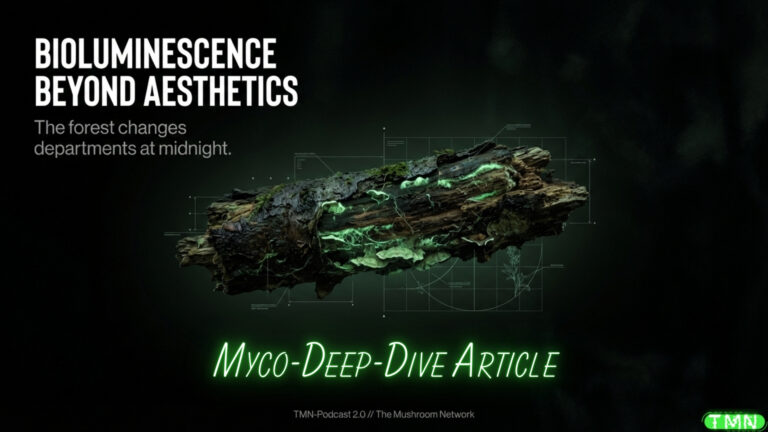
At night, parts of the forest don’t go dark — they glow. Bioluminescent fungi emit cold green light through a highly efficient chemical reaction that may function as both metabolic detox and ecological signaling. What looks like woodland ambiance might actually be evolutionary strategy. And once you realize nature doesn’t waste energy on aesthetics, the glow stops being magical and starts being deeply suspicious.