Predators of the Undergrowth: Fungi vs Venom
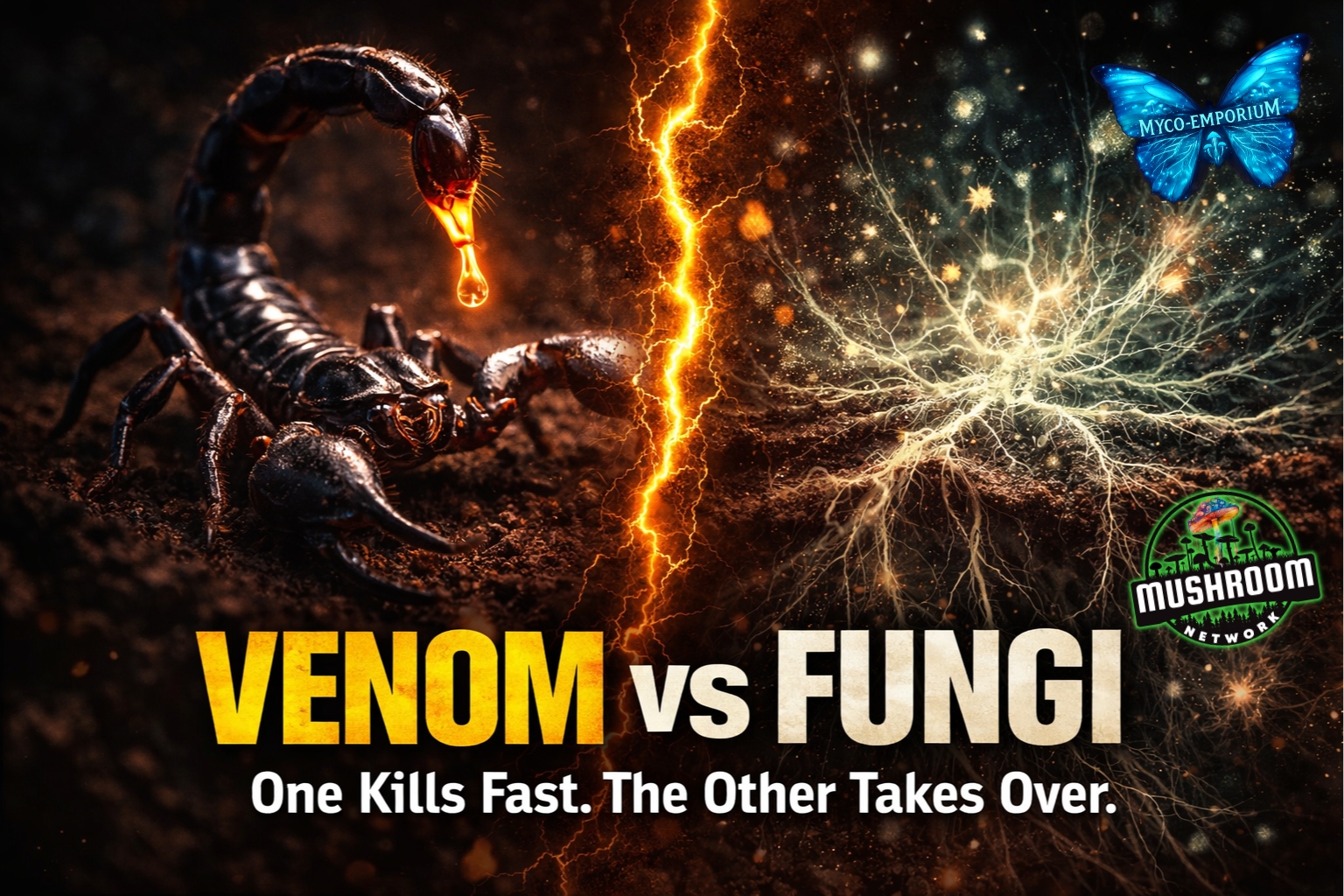
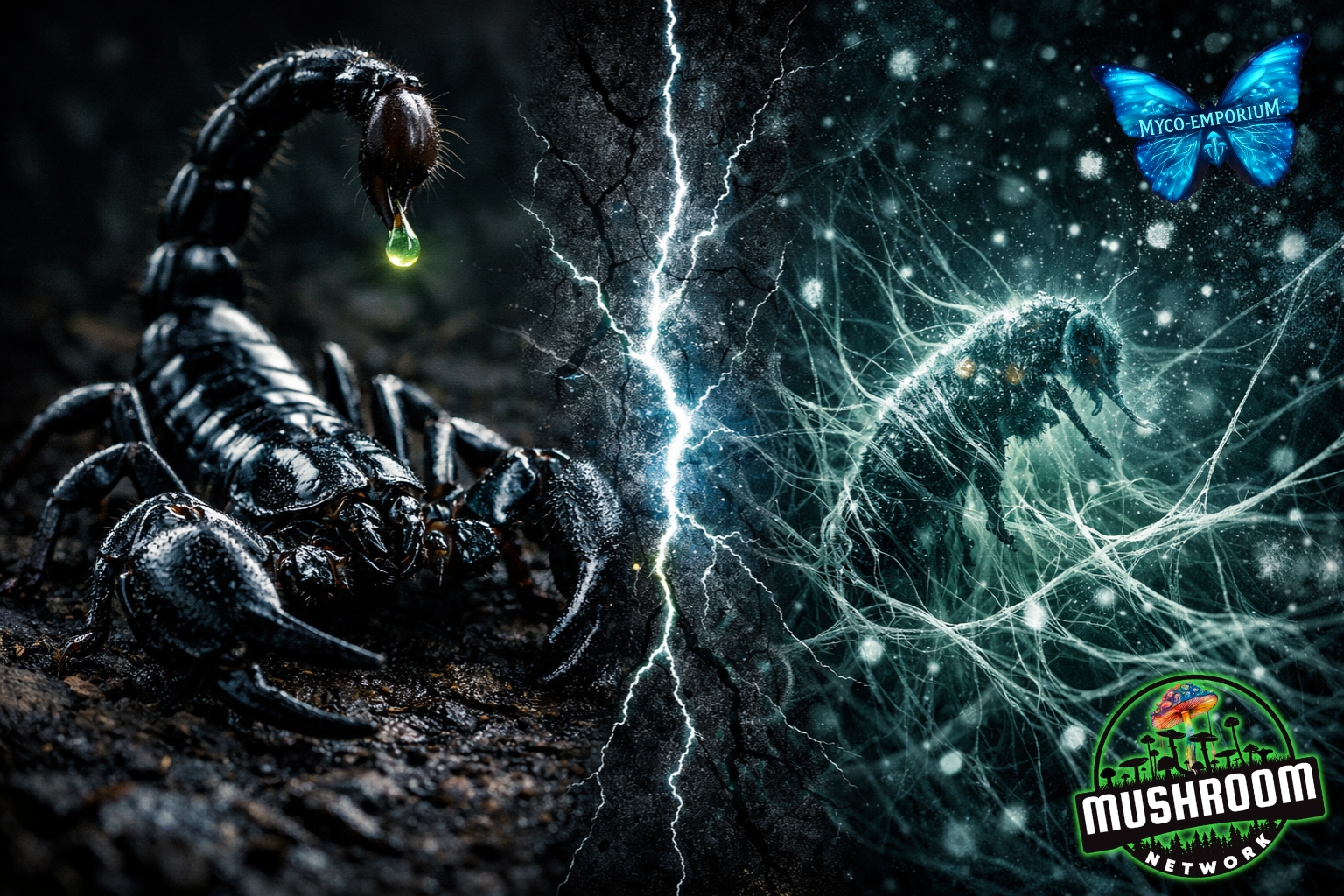
One injects. The other invades. Choose your nightmare.
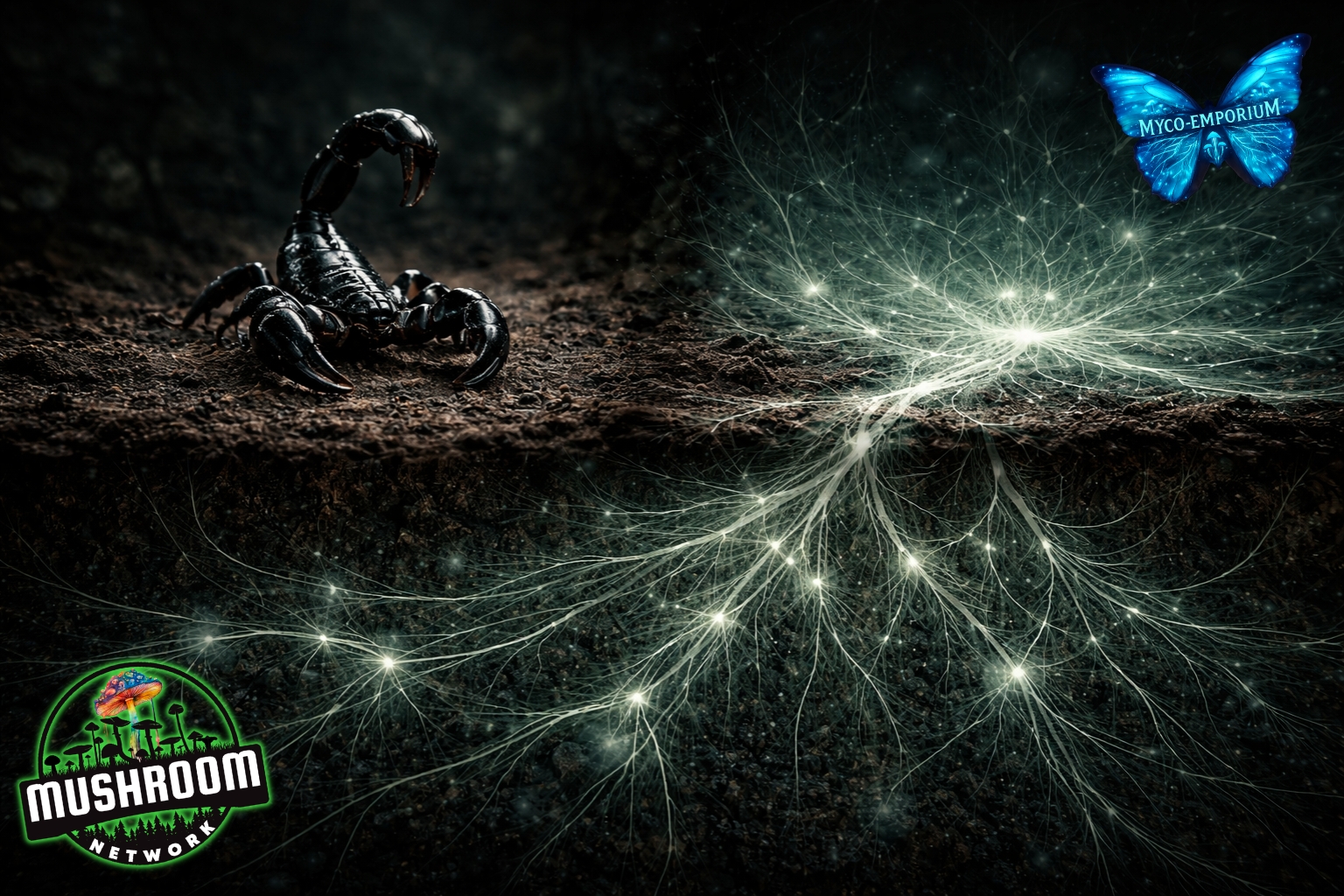
The scorpion strikes fast. Venom floods the body. Muscles seize. Systems collapse.
Now imagine something slower… something that doesn’t stab you, doesn’t chase you, doesn’t even bother with the theatrical decency of looking dangerous… but quietly lands on you and starts editing your biology from the inside.
One is a weapon. The other is a strategy.
And the uncomfortable truth? The slower one often wins.
Welcome to the fight you never saw coming: sting vs spore.
The Predator You Can See vs The One You Can’t
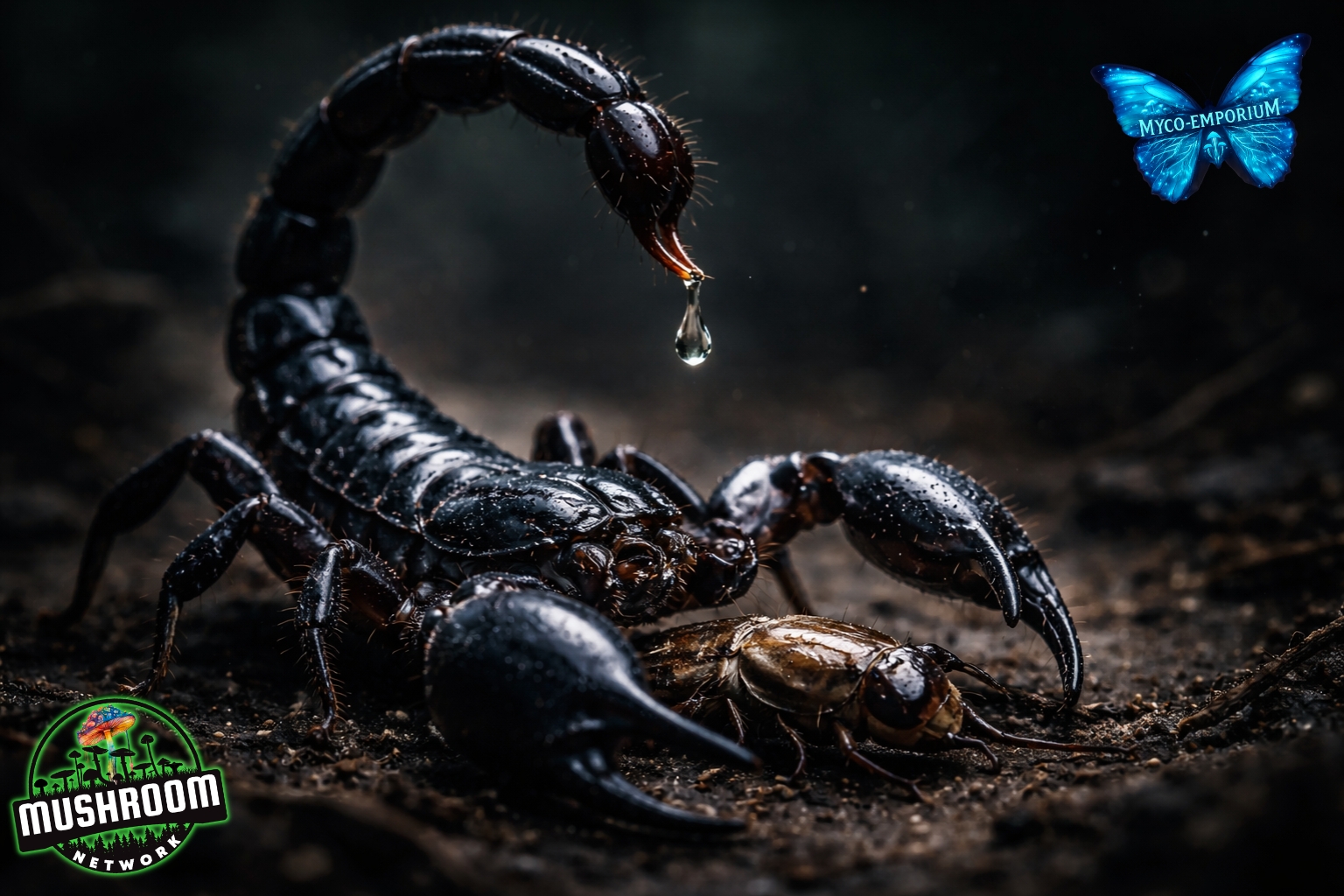
When we think of predators, we imagine speed, claws, jaws, fangs—something with enough cinematic self-respect to arrive dramatically. We expect the kind of menace that earns a slow-motion replay and a documentary whisper like, “Here, the hunter commits a felony in 4K.” A Black Asian Forest Scorpion fits that fantasy almost too well: armored, deliberate, shiny in that “nature built a weapon and lacquered it” sort of way, carrying venom designed to sabotage nerve signals with the efficiency of a biochemical mugging.
It makes immediate sense to us. Scorpion equals danger. Sting equals pain. Everyone understands that equation. It is clean, brutal, visible. A scorpion does not hide the vibe. It walks around looking like a medieval can opener with opinions.
Fungi, meanwhile, look like they were assembled from leftovers. No eyes. No teeth. No sprint sequence. No dramatic leap from the shadows. Just spores. Tiny, drifting, nearly invisible particles floating around like dust with malicious graduate degrees. If the scorpion kicks the door in, fungi are already inside, rearranging the furniture.
And yet this is where the floor starts tilting.
Because fungi do not simply kill. They infiltrate, dissolve, manipulate, and repurpose. Their attack is less a strike than a hostile takeover. Venom says, “Stop moving.” Fungi say, “Actually, keep moving. We have plans for you.” One interrupts the body. The other starts negotiating directly with its architecture, and fungi negotiate like arsonists holding a chemistry set.
This is not merely a comparison of weapons. It is a comparison of philosophies. Venom is speed, precision, immediate leverage. Fungal predation is patience, chemistry, and the kind of long-game audacity that makes ambush predators look impatient. One of these systems evolved to end a moment. The other evolved to commandeer a process.
And that is the part nobody tells you: some of the most advanced predators on Earth do not look like predators at all. They look like stains, threads, fuzz, growth, accident, decay. They look like something the forest forgot to clean up. Meanwhile, under that humble aesthetic, fungi have been quietly refining biological warfare for over a billion years, which is a deeply unsettling amount of time to get good at ruining someone else’s day.
The scorpion enters the story like a knife fight. The fungus enters like a paperwork error that ends civilization. And now we have to talk about the knife first.

Venom: Precision Strikes in Liquid Form
Venom is not just poison. Poison is broad. Poison is messy. Poison is the biochemical equivalent of yelling “good luck, idiot” and hoping for the best. Venom is different. Venom is targeted. Delivered. Tuned. Venom is poison in a tailored suit carrying a tablet, a badge, and a very specific agenda.
When a scorpion stings, it injects a carefully evolved cocktail of compounds—often neurotoxins—that interfere with ion channels in nerve cells. These channels control the movement of sodium, potassium, calcium, and other charged particles that make nerve signaling possible. In plain English: your nervous system runs on tightly regulated electrical chatter, and venom barges in like a raccoon in a server room.
That matters because nerves do not merely “send messages.” They maintain exquisite timing. Fire now. Pause now. Contract this muscle. Ignore that sensation. Hold position. React. Reset. A venom molecule does not need to destroy the entire system to cause mayhem; it only needs to jam the timing. That is the holy-crap inversion. Venom often wins not by blowing up the machine, but by convincing the machine to malfunction in public.
So the prey does not always just collapse like a puppet with cut strings. Sometimes it seizes, spasms, misfires, or locks up because the body’s own electrical logic has been turned into nonsense. It is less “off switch” and more “your operating system has been replaced with screaming.” Imagine every light switch in your house suddenly controlling a different appliance, while the toaster develops ambition. That is the vibe.
And here is the deliciously brutal logic behind it: venom frequently does not want immediate death. Immediate death can be inefficient. A predator often benefits more from prey that is immobilized, not liquefied; paused, not spoiled. Many venoms are optimized to paralyze rather than instantly kill because fresh prey is easier to manage than decomposing prey. Venom is not always a death sentence first. It is often a compliance tool. A biological “please remain still while being processed.”
That point deserves to sit on your chest for a moment. The sting is not always an execution. Sometimes it is customer service for digestion.
And venom gets even more elegant the closer you look. Different compounds can target different ion channels and receptors with extraordinary specificity. One toxin may prolong channel opening. Another may prevent closing. Another may block the signal entirely. This is modular sabotage. Evolution has essentially assembled a wet chemistry toolkit full of “break glass in case of prey.” It is precision engineering with the emotional energy of a mugging in an alley behind a neuroscience conference.
Naturally, this also explains why venom feels so cinematic to us. It is immediate. You can point to the event. There was a strike. There was a delivery. Cause and effect stand next to each other in broad daylight. The predator did something, and then the prey experienced consequences. Our brains love that narrative because it is obvious. Even the terror has manners.
But that clarity hides the limitation.
Venom requires contact.
Venom needs a delivery mechanism.
A sting. A bite. A puncture. Proximity. Timing. Opportunity.
There must be a meeting.
And fungi, in one of evolution’s most disrespectful design choices, looked at that entire requirement and said: absolutely not. Why build a syringe when you can become weather? Why schedule an attack when you can drift into the room like biochemical glitter from hell? The scorpion needs a moment. The fungus only needs a landing.
Because this was the warm-up. Now we get to the predator that does not strike prey so much as slowly convert it into a management position.



The Takeover: How Fungi Turn Bodies Into Infrastructure
Fungi do not inject. They infiltrate.
A spore lands, and the event is almost offensively unimpressive. No dramatic music. No battle cry. No warning label peeling itself across the screen. Just a microscopic particle arriving with the same visual charisma as dust. If venom is a jump scare, fungal infection is a subtle typo in a contract that later costs you the building.
But once a spore germinates, the politeness ends.
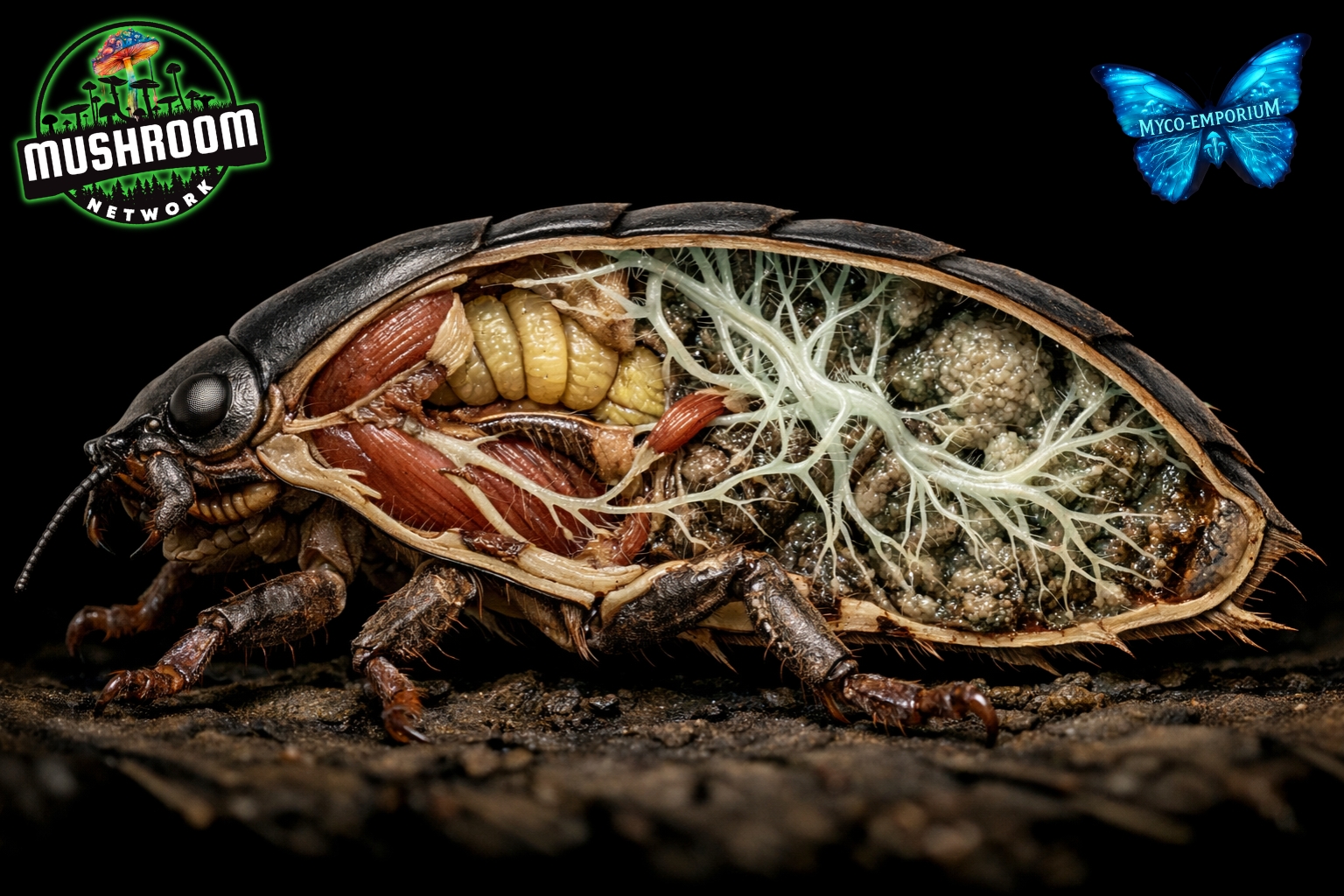
Fungi begin secreting enzymes—proteases, chitinases, lipases, and other molecular tools—that break down the physical components of a host. Proteases cut through proteins. Chitinases help dismantle chitin, a critical structural material in insect exoskeletons and fungal cell walls. Lipases help break down fats. This is chemistry with a pry bar. Not explosive destruction, but systematic disassembly. Piece by piece. Barrier by barrier. Molecule by molecule.
And that is the first major double-take: fungal predation is often not a dramatic kill shot. It is managed collapse. It is your body being audited by soup.
Think of it like a demolition crew that shows up wearing clean vests, unfolds blueprints, compliments your foundation, and then quietly removes your load-bearing reality. The scorpion gives you an emergency. The fungus opens a project file.
Here is the part that tends to make readers stare into the middle distance for a second: some fungi do not simply kill insects. They manipulate them first.
Species in the Ophiocordyceps group have become famous for infecting ants and altering behavior in ways that benefit fungal reproduction. The infected ant leaves normal routines, climbs vegetation, and clamps down in a so-called death grip before the fungus consumes the host and later erupts from the body to release spores from an elevated position. Let’s not sprint past that like it is remotely normal. The fungus does not merely use the ant as food. It uses the ant as transportation, positioning system, and launch architecture.
That is not “rot.”
That is strategic body management.
Callback time: earlier, venom was the hacker freezing your keyboard while it rummaged through your files. Fungi are worse. Fungi do not freeze the keyboard. Fungi send emails from your account, change your passwords, redecorate your office, and list your skeleton as company property.
Now, to keep this grounded: the exact mechanisms behind fungal behavioral manipulation are still being studied in detail, and the system is complex. Fungi may influence host tissues and signaling in ways that change movement, timing, and behavior. Scientists are still working out how much is direct neural interference, how much is muscular or systemic disruption, and how fungal metabolites coordinate the whole grim pageant. But the broad pattern is undeniable: in some systems, the host’s behavior is altered in ways that strongly benefit the parasite’s life cycle.
Which is frankly a sentence that should trigger ominous cello music.
And unlike venom, fungi do not have to hurry. That is one of their nastiest advantages. Venom has an event window. Fungi can unfold over hours, days, or longer, slowly breaching defenses, digesting tissues, rerouting resources, and converting a living body into nutrients plus future dispersal hardware. The host becomes meal and machinery. Food and ladder. Corpse and billboard.
This is where fungal predation starts to feel less like hunting and more like urban planning.
Here is the real-world relevance, because nature is never content to be weird in isolation: entomopathogenic fungi are used in agriculture and pest management as biological control agents. Instead of relying only on synthetic pesticides, humans have harnessed fungi that infect and kill insect pests. Which means our species examined a lineage of organisms capable of chemically breaching, colonizing, and terminating insect bodies from the inside and responded with, “Excellent. Let’s put them to work.”
To be fair, that can be incredibly useful and ecologically valuable. But it is still one of those moments where humanity sounds like a raccoon wearing safety goggles.
And now it gets weirder, scientifically. Venom incapacitates. Fungi transform. Incapacitation is a moment; transformation is a process. A sting can end control. A fungal infection can replace it. And that is much harder to fight, because the threat is not simply an external force pressing inward. The threat becomes a pattern unfolding through the host itself.
Force is obvious.
Takeover is sneaky.
And sneakiness with enzymes is where forests keep their most unsettling innovations.
So now we have the uncomfortable question sitting on the table like an unpaid curse:
What do we call a predator that does not just kill prey, but turns prey into infrastructure?


When Predators Become Systems: Rethinking What “Hunting” Means
If venom is a weapon, fungi are a system.
That distinction is everything.
Venom evolved for immediacy: defense, capture, fast leverage. It creates rapid outcomes in discrete encounters. A predator meets prey, deploys chemistry, and secures an advantage. Elegant. Efficient. Extremely rude. It is a biological heist executed in one scene.
Fungi, by contrast, behave like a distributed campaign. They do not need the spectacle of contact. They do not need a dramatic chase. They can disperse through spores, persist in environments, wait for opportunity, infiltrate when conditions align, and then transform the host into fuel for the next round. What looks passive from the outside is actually patience weaponized.
Here is the deeper inversion: fungi blur the line between predator and environment. Once they infect a host, they are no longer merely acting upon the body from outside. They are inside the system, using its nutrients, occupying its tissues, influencing its function, and eventually converting it into a reproductive platform. The “kill” is not the endpoint. It is one stage in a larger logistical operation.
That means predation stops being just an event and starts becoming a process.
The host becomes food.
Then architecture.
Then launch pad.
Then part of the landscape’s biochemical bookkeeping.
Which is why the old image of the predator—fangs, pursuit, impact—suddenly feels too narrow. We built our definition around drama because drama is easy to notice. But evolution is not trying to be legible to us. It is trying to work. Quietly, efficiently, repeatedly. Fungi are what happens when predation stops caring whether the audience understands the plot.
Remember earlier when the scorpion rolled in like a tiny armored assassin with a fluid dynamics minor? Very impressive. Very sleek. Nature’s little tactical nightmare. Fungi looked at that performance, adjusted their invisible tie, and said, “Adorable. We’ll be taking procurement, transportation, and postmortem real estate development.”
That is the callback, but it also happens to be the point.
Venom reacts to presence. A target is there, the chemistry is delivered, and advantage is seized. Fungi do something stranger. They position themselves where a host is likely to be, disperse widely enough for chance to become a hunting partner, and rely on persistence to do what speed does for other predators. Probability becomes part of the predatory apparatus. The forest itself begins to feel like a delivery mechanism.
That is a very different philosophy of power.
It also pushes us toward a bigger question about intelligence—not consciousness, not intention in the human sense, but evolutionary strategy. Venoms are astonishing examples of precision chemistry, but fungal systems often look eerily anticipatory. Not because the fungus is sitting there plotting like a tiny villain in a velvet chair, but because natural selection can produce life cycles that exploit behavior, location, humidity, anatomy, and timing with almost offensive efficiency. The result feels strategic because it is strategically filtered, even if no one is “thinking” it through.
And that should make every Myco-Patron do at least one respectful full-body shiver.
Because now the forest is no longer a place where predators merely leap from shadows. It is also a place where a predator can be dust, timing, chemistry, and patience. A place where the attack might look like nothing happening. A place where stillness is not safety but camouflage for process.
Difficulty to see has never meant lack of power. Usually it means the power has moved past needing your approval.
So perhaps we have been defining “hunter” too narrowly. Perhaps we have mistaken noise for dominance. Perhaps the sharpest biochemical predators on Earth are not the ones that stab, bite, or chase, but the ones that can make a body continue participating in its own defeat.
And that brings us to the final, unpleasantly elegant truth.
🌟 MycoTip the Network! 🌟
themushroomnetwork@vipsats.app
🌀 Myco-Conclusion: The Predator You Never Felt Coming
Venom dazzles us because it behaves the way danger is supposed to behave. It is visible. Immediate. Kinetic. It enters the story with theater. A sting is an announcement. A bite is a headline. Even the fear has shape.
Fungi are different.
Fungi operate like a whisper that slowly acquires legal authority.
They do not need to burst into the room. They can arrive as particles, settle as possibility, germinate as chemistry, and expand as process. They do not merely overpower the body. They can become involved with it. They can turn structure into nutrient, movement into delivery, death into infrastructure, and one victim into a platform for many future attempts. That is not just predation. That is systems design wearing mold.
So here is the cosmic question at the root of all this rot:
What if the most powerful predators are not the ones that strike hardest, but the ones that become part of the world so thoroughly that prey can no longer tell where the hunter ends and the environment begins?
In a world obsessed with speed, fungi offer a much stranger lesson. Patience, armed with chemistry, can outperform violence. Persistence can outperform spectacle. The slow thing is not always the weak thing. Sometimes the slow thing is simply playing a longer game than your nervous system knows how to comprehend.
The scorpion still deserves respect. Absolutely. Tiny armored nightmare. No notes. But fungi force us to widen the definition of fear. Not because they are louder, faster, or more dramatic. Because they are quieter. More thorough. More infrastructural. They do not just win moments. They can win conditions.
And somewhere in the undergrowth, right now, a spore is landing with all the visual drama of dust on a windowsill.
No roar. No warning. No villain speech.
Just the microscopic equivalent of a hand setting down a briefcase and saying, with horrifying professionalism:
This body will do.


Suggested Myco-Articles For You:

Foraging with the Myco-Wanderer: What Not to Lick in the Woods
You’re wandering the woods. A cute little mushroom smiles at you like a snack. Should you lick it? NO. This Myco-Wanderer survival article is your ultimate guide to identifying (and not
Read More...
Fungi & the Akashic Records: Are Mushrooms the Librarians of the Universe?
Are mushrooms just medicine… or are they cosmic librarians disguised as forest snacks? This article dives into the wild mycelial speculation that fungi are more than biological wonders—they may be key access points to the Akashic Records
Read More...
Mycelium as Memory: Could Forests Be Conscious?
Is the forest… conscious
Read More...
Golden Intruders: Michigan Warns of Oyster Mushroom Escape
They look like sunshine on a log and taste like they were designed by a Michelin chef. But Michigan’s Department of Natural Resources
Read More...Myco-Article v1.0.4 [Bravo]
How sporetacular was this post?
Tap a star to send your spores of approval (or helpful feedback!)
Oh no! The spores missed their mark…
Let’s co-create a sporetacular post together!
Share your wisdom—how can we make this more Cosmic?